
From Ancient Healing to Modern Lymphatic Science
How an overlooked body system became one of the fastest-growing areas in rehabilitation, cancer care, recovery and wellness.
There was a time when almost nobody talked about the lymphatic system.
Now it seems to be everywhere.
Social media talks about “lymphatic drainage facials.”
Wellness clinics advertise detox.
Compression garments are appearing in gyms and beauty clinics.
Post-surgical recovery work is growing rapidly.
Cancer survivorship is increasing.
Research into inflammation, immunity and even the brain’s drainage system is expanding every year.
And somewhere in the middle of all of this sits Manual Lymphatic Drainage (MLD) — a gentle hands-on treatment that has quietly evolved from historical observation into a recognised part of modern lymphoedema and rehabilitation care.
As someone who works with swelling, scars, cancer recovery, movement, breathing and chronic conditions, I find the history of MLD fascinating because it reflects something much bigger:
The body has always been trying to tell us that fluid matters.
We just did not fully understand it yet.
Humans noticed swelling long before they understood the lymphatic system
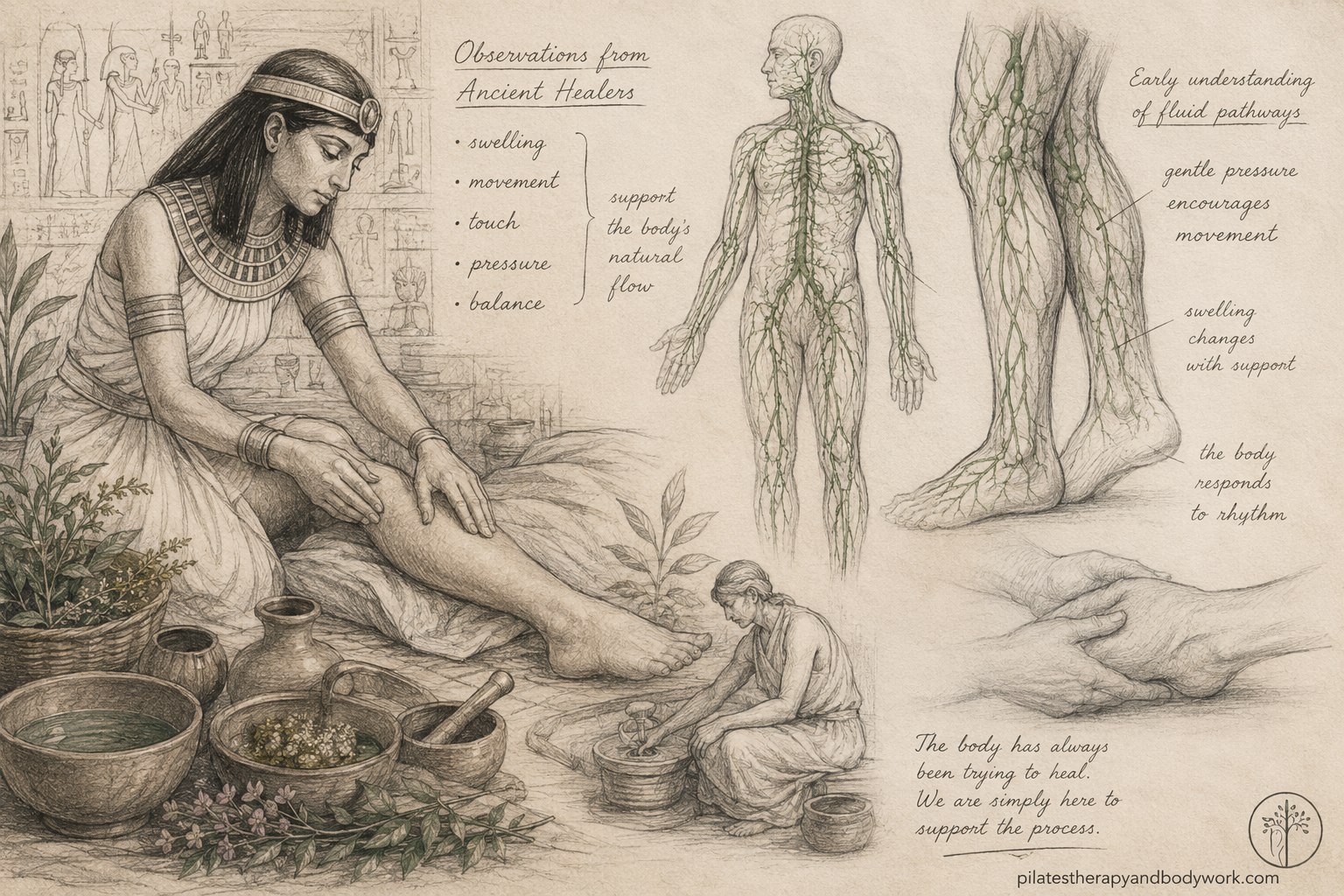
Long before anatomy textbooks existed, people noticed patterns.
Swelling after injury.
Heavy legs.
Fluid changes.
Tender tissues.
Changes after illness.
Ancient civilisations including the Egyptians and Greeks used massage, bathing, movement and touch to help support circulation and wellbeing. They did not understand lymphatic physiology in the way we do now, but they understood that the body responded to rhythm, movement and pressure.
And honestly?
In many ways that still matters now.
Because even with all our modern technology, much of lymphatic care still relies on observation:
- tissue texture,
- swelling patterns,
- skin changes,
- movement,
- breathing,
- posture,
- pain,
- and how a person functions day to day.
The body often tells a story before scans or measurements do.
The lymphatic system was one of the last body systems to be understood
For something so important, the lymphatic system stayed hidden for a surprisingly long time.
Partly because lymphatic vessels are tiny.
Partly because they collapse easily.
And partly because they are transparent and difficult to study compared to arteries or bones.
Emil and Estrid Vodder changed the direction of lymphatic therapy
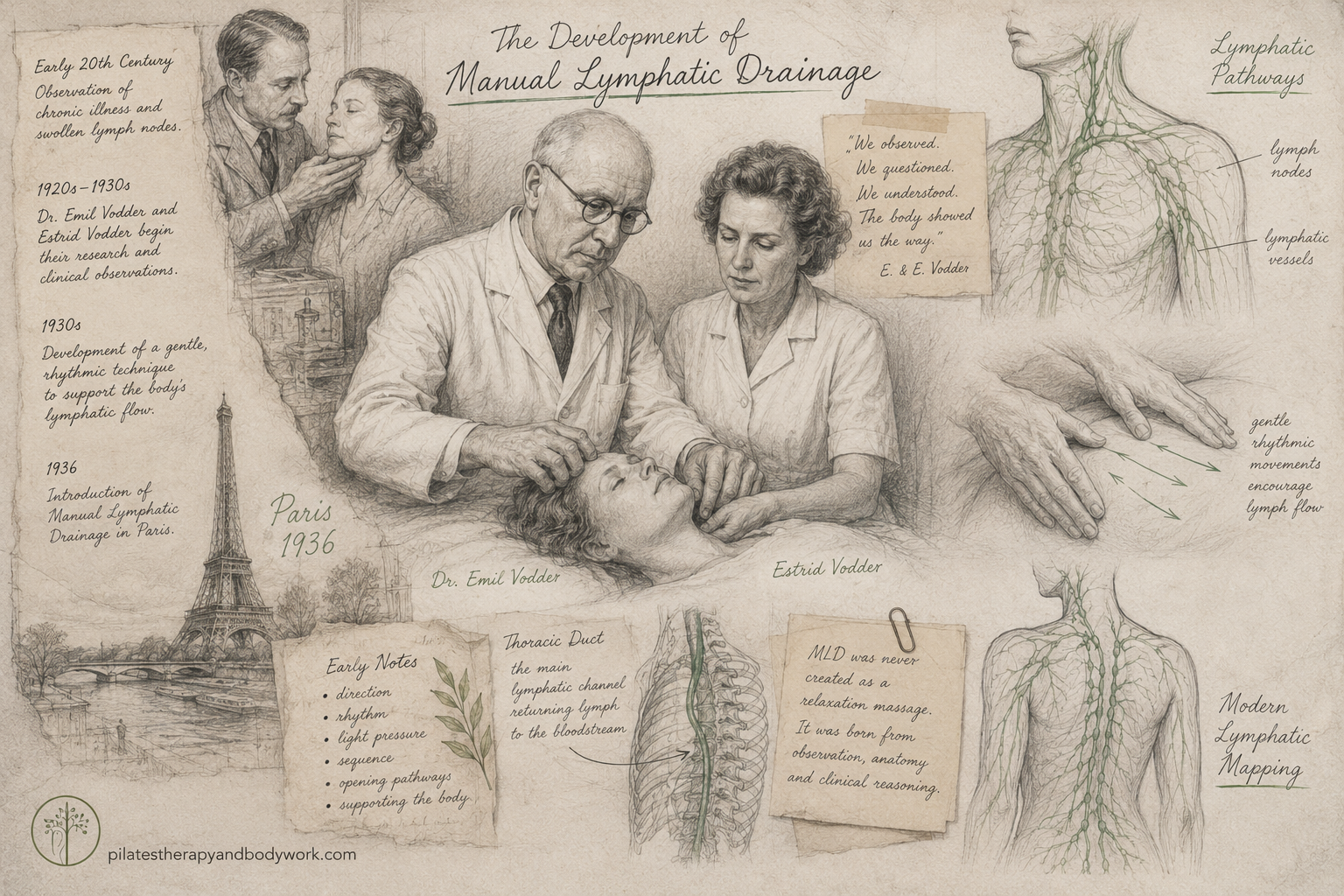
In 1622, Gaspare Aselli identified lymphatic vessels in animals, describing them as milky-looking channels involved in digestion. Later discoveries by Jean Pecquet helped identify the thoracic duct — the major drainage pathway returning lymphatic fluid back toward the bloodstream.
Slowly, anatomy started piecing the puzzle together.
But even today, many people still do not really know what the lymphatic system does.
And honestly, that is not surprising.
Most people are taught about:
- the heart,
- lungs,
- muscles,
- bones.
Very few people are taught about:
- lymph flow,
- tissue pressure,
- fluid balance,
- immune transport,
- or how swelling develops.
Yet the lymphatic system quietly connects all of them.
In the 1930s, Danish practitioners Dr Emil Vodder and Estrid Vodder began observing patients with chronic illness and swollen lymph nodes.
At the time, many practitioners avoided swollen nodes completely.
But the Vodders noticed something interesting:
gentle rhythmic touch appeared to help some patients.
They developed a very specific style of treatment using:
- light pressure,
- rhythmic stretching,
- directional movement,
- and carefully sequenced techniques designed to encourage lymphatic flow.
In 1936, they introduced Manual Lymphatic Drainage in Paris.
Initially, many people were sceptical.
Now their work forms part of the foundation for modern lymphatic drainage education worldwide.
And this part matters:
MLD was never simply designed as “relaxation massage.”
It developed from anatomical observation, clinical reasoning and evolving understanding of fluid dynamics and tissue health.
That difference matters more than ever now.
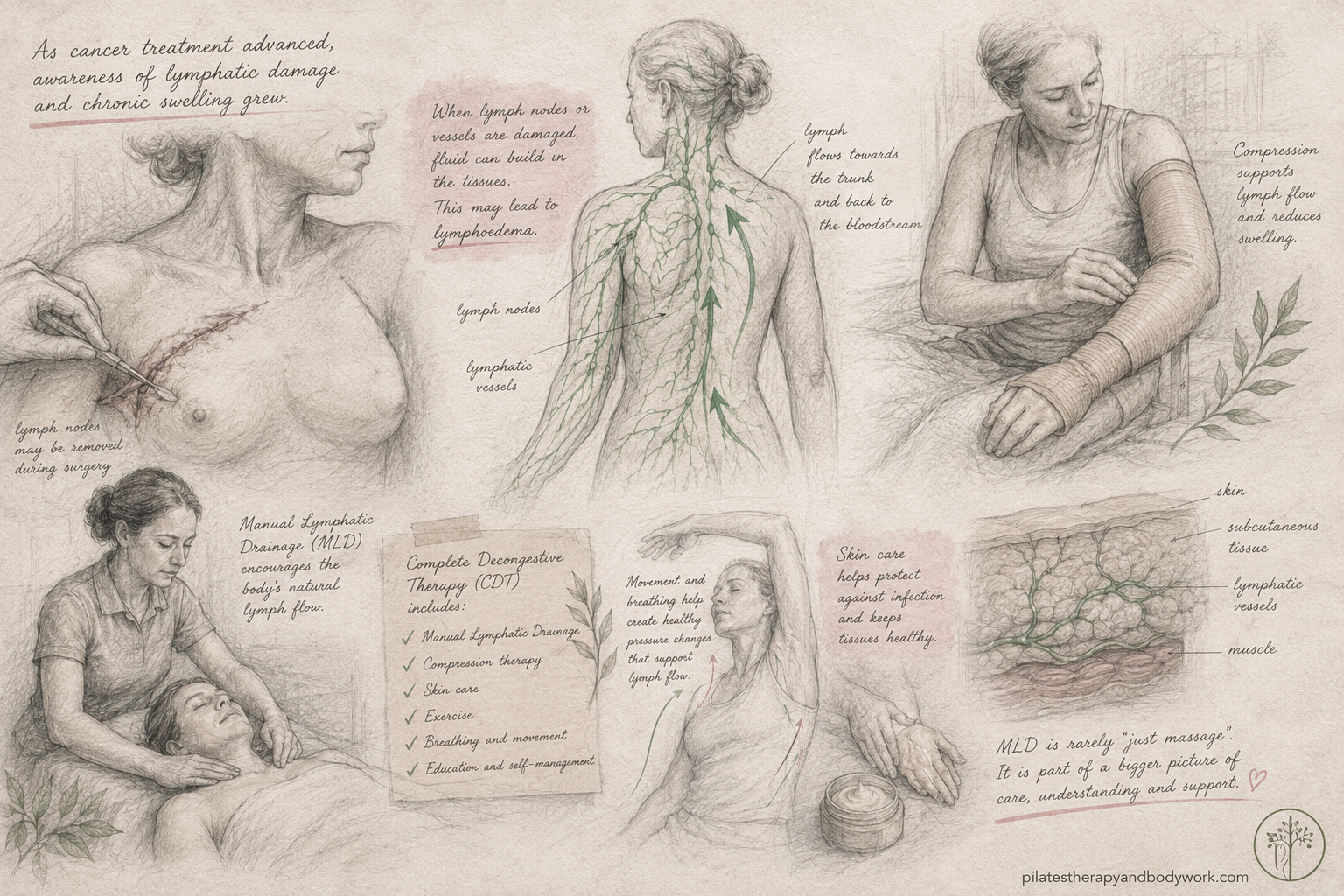
“As cancer survival increased, so did awareness of lymphatic damage and chronic swelling.”
One of the biggest turning points in lymphatic care came through cancer treatment.
As surgery and radiotherapy advanced, more people survived cancer — but many also developed long-term swelling problems after lymph nodes or vessels were damaged.
This led to growing awareness of lymphoedema.
According to the British Lymphology Society, chronic oedema and lymphoedema affect a significant and growing number of people in the UK, particularly alongside:
- cancer treatment,
- obesity,
- vascular disease,
- immobility,
- ageing,
- and chronic illness.
Modern lymphoedema care often includes:
- Manual Lymphatic Drainage,
- compression therapy,
- skin care,
- exercise,
- breathing work,
- movement rehabilitation,
- and education.
This combined approach is often known as Complete Decongestive Therapy (CDT).
And this is important:
MLD is rarely “just massage.”
In clinical settings it sits inside a much bigger picture involving:
- tissue health,
- infection risk,
- fibrosis,
- pressure systems,
- movement,
- skin integrity,
- and long-term self-management.
The lymphatic system has gone from overlooked… to fashionable
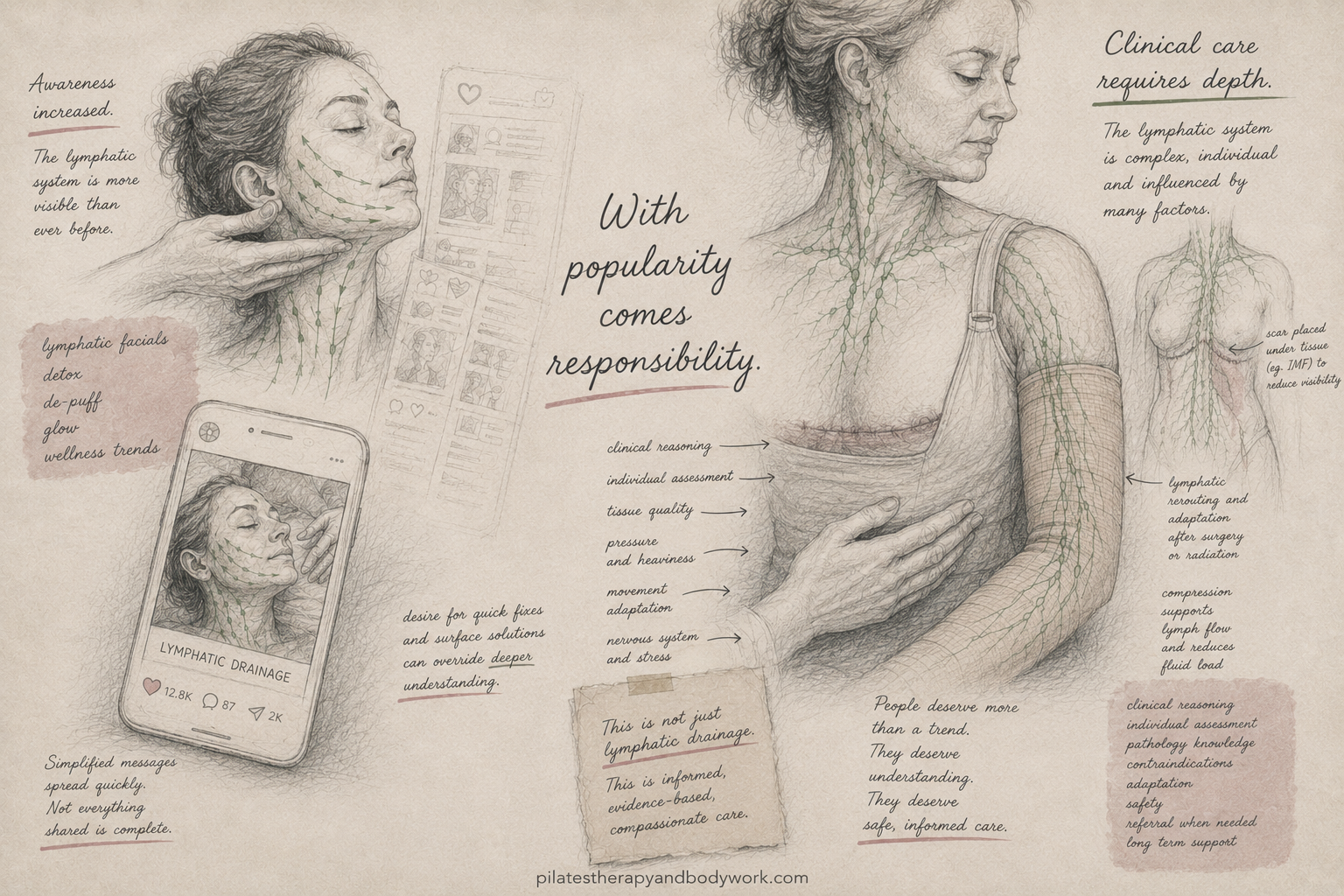
“With popularity comes responsibility.”
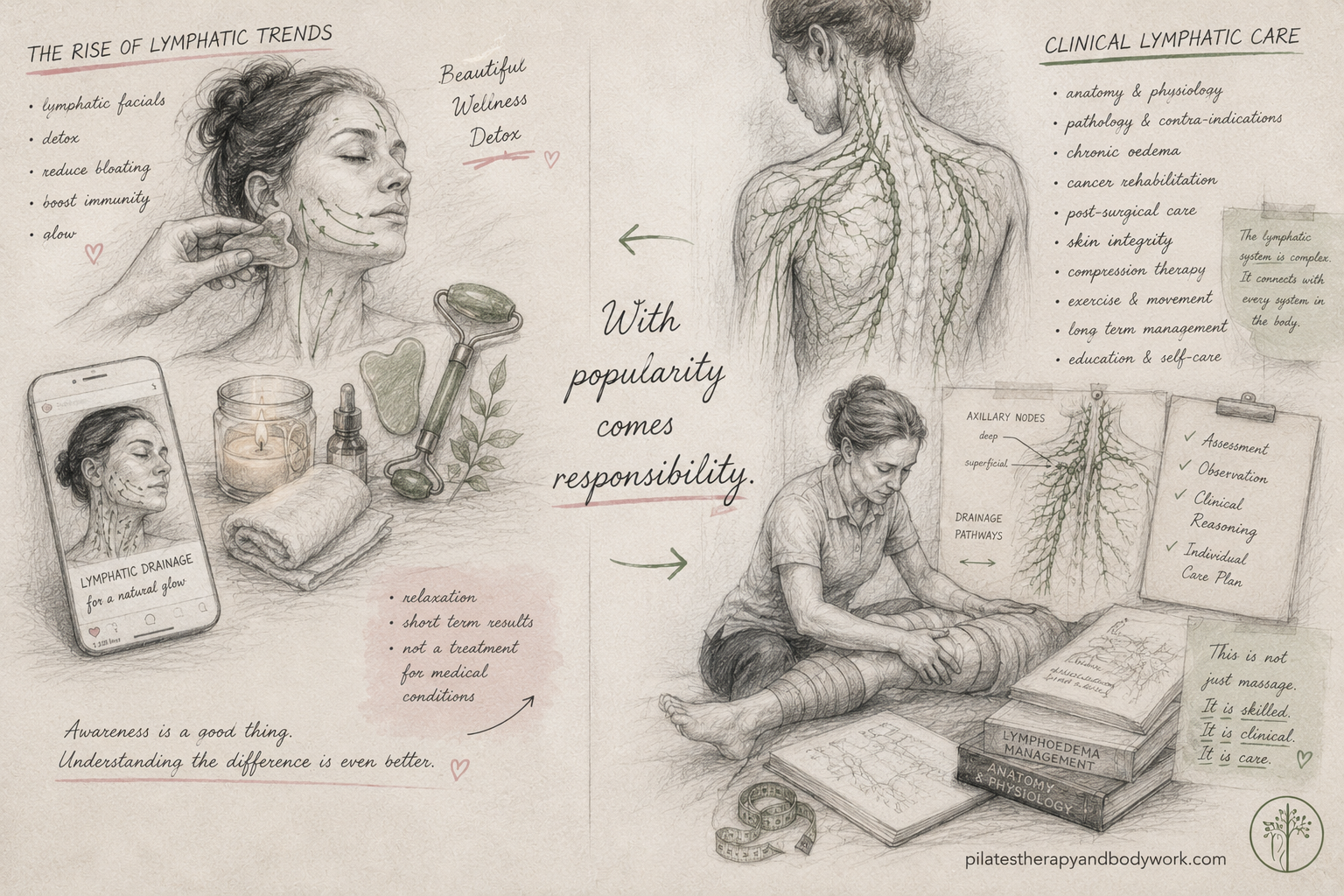
Over the last few years, the lymphatic system has exploded into public awareness.
Some of this is genuinely positive.
People are becoming more aware of:
- swelling,
- recovery,
- post-surgical care,
- inflammation,
- movement,
- and the importance of fluid health.
But the popularity of “lymphatic drainage” has also created confusion.
A relaxing spa-style treatment is not the same thing as managing:
- medically compromised lymphatics,
- cancer-related swelling,
- lipedema,
- post-radiotherapy fibrosis,
- venous and lymphatic overload,
- or complex chronic oedema.
Those situations require deeper understanding.
Not because therapists need to sound clever.
But because people deserve safe, informed care.
And honestly?
The more I study the lymphatic system, the more I realise how much there still is to learn.
Why training standards matter
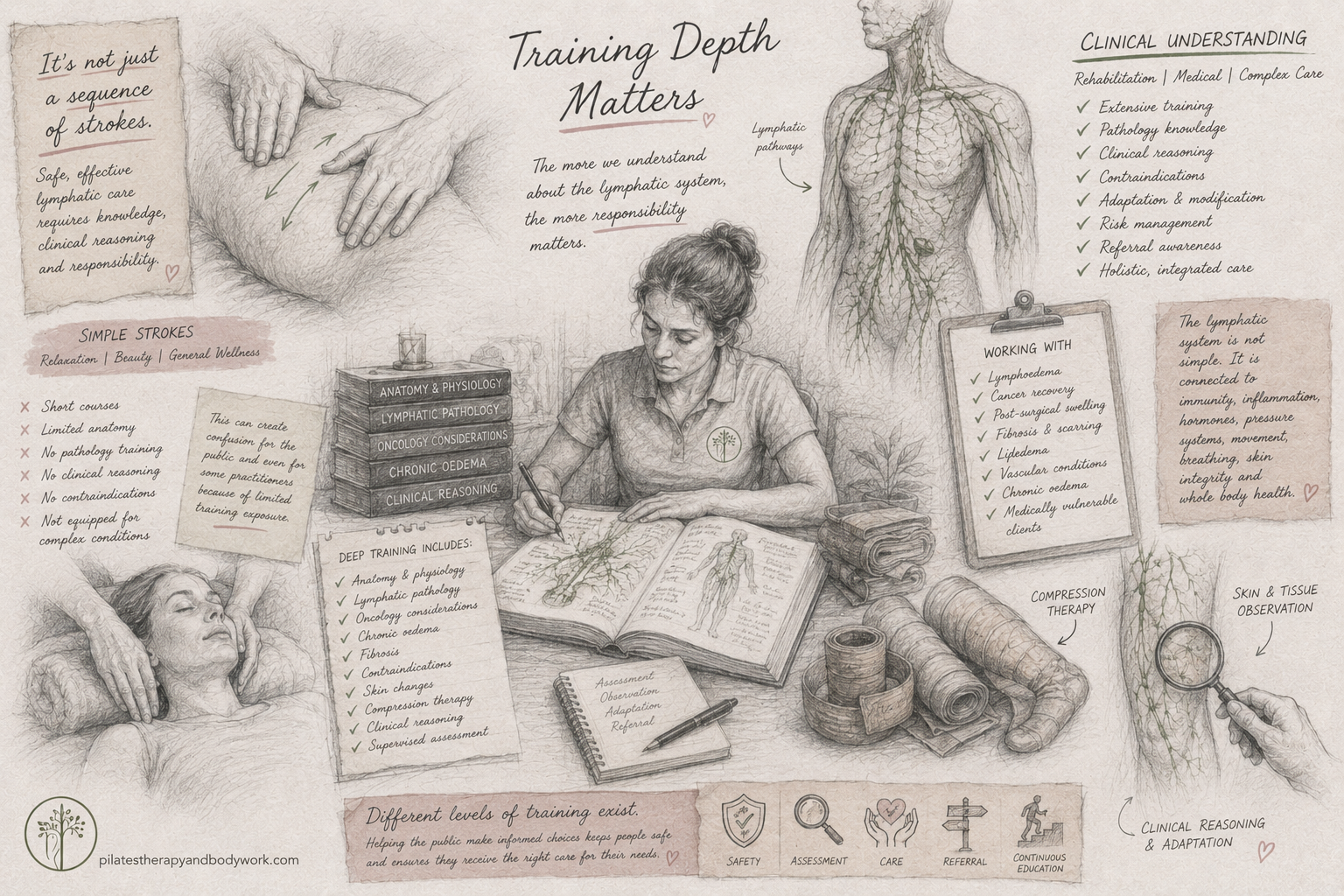
“The more we understand about the lymphatic system, the more responsibility matters.”
This is probably one of the most important conversations happening in lymphatic work right now.
As awareness of the lymphatic system grows, so does the number of courses and treatments being marketed as “Manual Lymphatic Drainage.”
Some training pathways involve extensive study in:
- anatomy and physiology,
- lymphatic pathology,
- oncology considerations,
- chronic oedema,
- fibrosis,
- contraindications,
- skin changes,
- compression therapy,
- clinical reasoning,
- and supervised practical assessment.
Other courses are much shorter and may focus primarily on relaxation, beauty or general wellness applications.
This can create confusion for the public, who may understandably assume all MLD training pathways are equivalent.
And honestly, I think some practitioners may also be confused about the complexity of the lymphatic system because of limited training exposure.
The lymphatic system is not simply a beauty trend or detox concept. It is a complex body system connected to:
- immunity,
- inflammation,
- vascular health,
- surgery,
- cancer treatment,
- chronic swelling,
- skin integrity,
- breathing mechanics,
- and tissue pressure regulation.
A therapist working with medically vulnerable clients — particularly people with lymphoedema, cancer histories, significant swelling or complex health conditions — needs far more than a sequence of massage strokes.
They need clinical understanding and the ability to recognise when something may require referral, modification or caution.
As research evolves, many practitioners are now choosing more advanced education pathways because the work itself is becoming more specialised and evidence-informed.
This is not about hierarchy or criticising therapists who are learning and expanding their skills.
It is about recognising that different levels of training exist — and helping the public make informed decisions about the type of support they may need.
The more we understand about the lymphatic system, the more we realise how connected it is to the rest of the body.
And with that growing understanding comes responsibility.
The future of lymphatic science is only just beginning
“The lymphatic system is no longer overlooked — and we are still only beginning to understand it.”
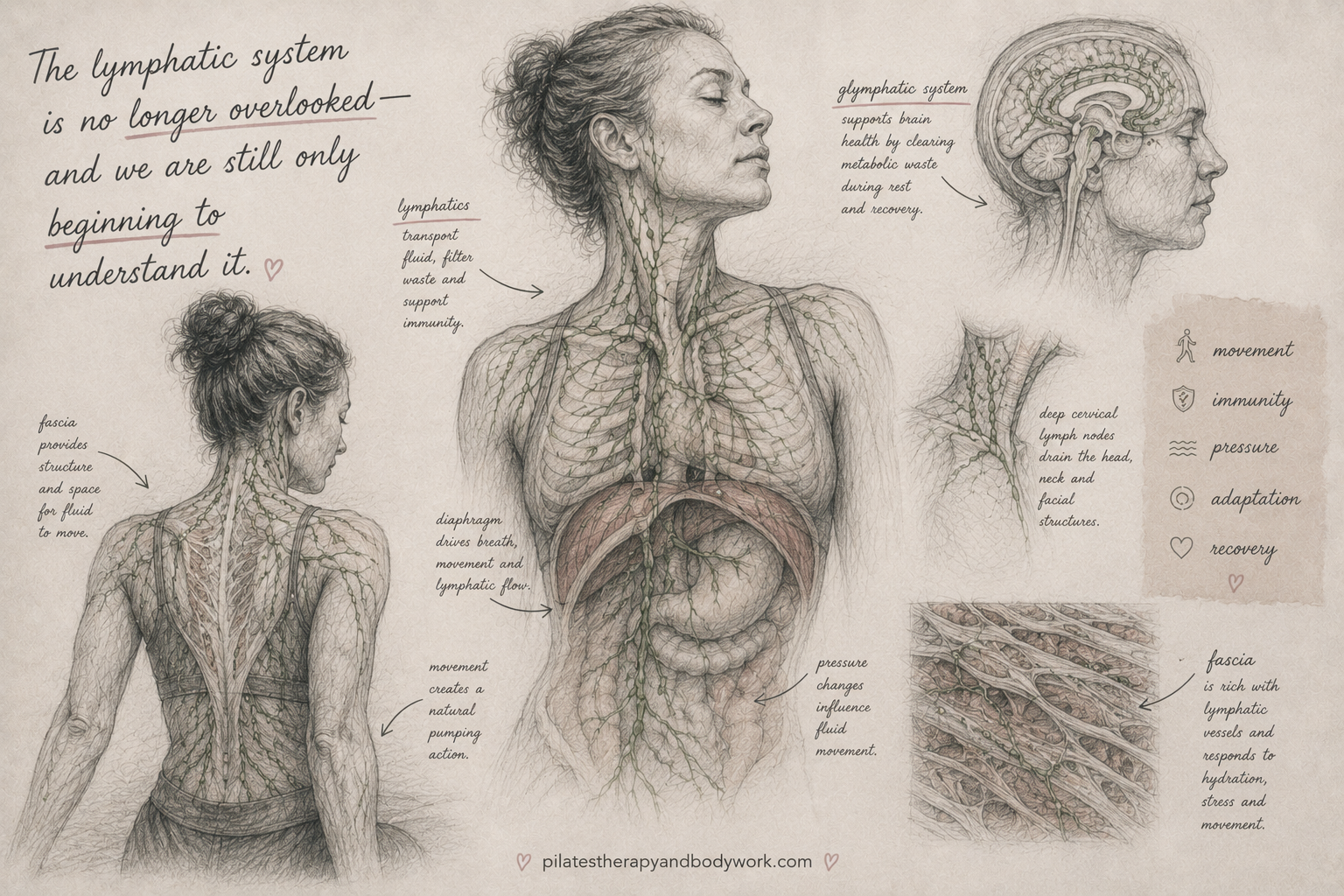
One of the most exciting things about lymphatic science is that we are still discovering new connections.
Research is now exploring:
- inflammation,
- the glymphatic system in the brain,
- chronic oedema,
- obesity and lymphatic dysfunction,
- fascia and fluid relationships,
- post-surgical rehabilitation,
- scar tissue,
- exercise and lymphatic flow,
- breathing mechanics,
- and immune health.
The lymphatic system is no longer being viewed as a forgotten drainage network.
It is increasingly recognised as part of whole-body health.
And perhaps that is why this area keeps growing.
Not because it is trendy.
But because more people are beginning to recognise themselves in the symptoms:
- heaviness,
- swelling,
- fatigue,
- pressure,
- tissue tightness,
- recurrent infections,
- scar pulling,
- or the feeling that something just does not move properly anymore.
Sometimes understanding the system helps people finally feel seen.
The history of Manual Lymphatic Drainage is really the history of listening more carefully to the body.
From ancient observations of swelling…
to anatomical discovery…
to modern cancer rehabilitation and lymphoedema care…
the field continues to evolve.
And I suspect we are only at the beginning of understanding how important fluid, pressure, movement and tissue health truly are.
The lymphatic system has moved from being overlooked…
to becoming fashionable.
Now the challenge is making sure it is also understood responsibly.
Curious about swelling, lymphatic health or recovery support?
I offer gentle, clinically informed support including Manual Lymphatic Drainage, scar therapy, reflexology and movement rehabilitation in Clacton-on-Sea and Bury St Edmunds, supporting people living with swelling, cancer recovery, chronic conditions and post-surgical changes.
Whether you are navigating lymphoedema, heaviness, scar restriction, post-treatment recovery or simply trying to better understand your body, education and support matter.