
Understanding swelling, healing and Manual Lymphatic Drainage after tummy tucks, arm lifts and cosmetic surgery
Cosmetic surgery recovery is now discussed everywhere online.
Tummy tucks. Arm lifts. Liposuction. “Snatched” recovery videos. Dramatic before-and-after photographs. And increasingly, people are being told they need “lymphatic drainage massage” afterwards.
Recently, I treated a lady shortly after a tummy tuck. She had been cleared by her surgeon for Manual Lymphatic Drainage (MLD). Using gentle Vodder techniques, we slowly reduced visible swelling, and I showed her a few simple breathing and drainage techniques she could continue at home between sessions.
Afterwards, she said something that stayed with me.
She belonged to an online recovery group with hundreds of women who had undergone similar procedures. Some described their “MLD” treatments as extremely deep, painful and bruising afterwards.
That conversation matters.
Because immediately after surgery, the body is not asking to be attacked.
It is asking to heal.
And understanding what is happening inside the body from day one helps explain why gentler treatment often makes far more physiological sense.
Cosmetic surgery procedures continue to rise in the UK, with BAAPS reporting more than 25,000 cosmetic procedures performed in women in 2024, including thousands of body contouring procedures such as abdominoplasty (tummy tuck) and brachioplasty (arm lift).
“Immediately after surgery, the body shifts into protection and repair”
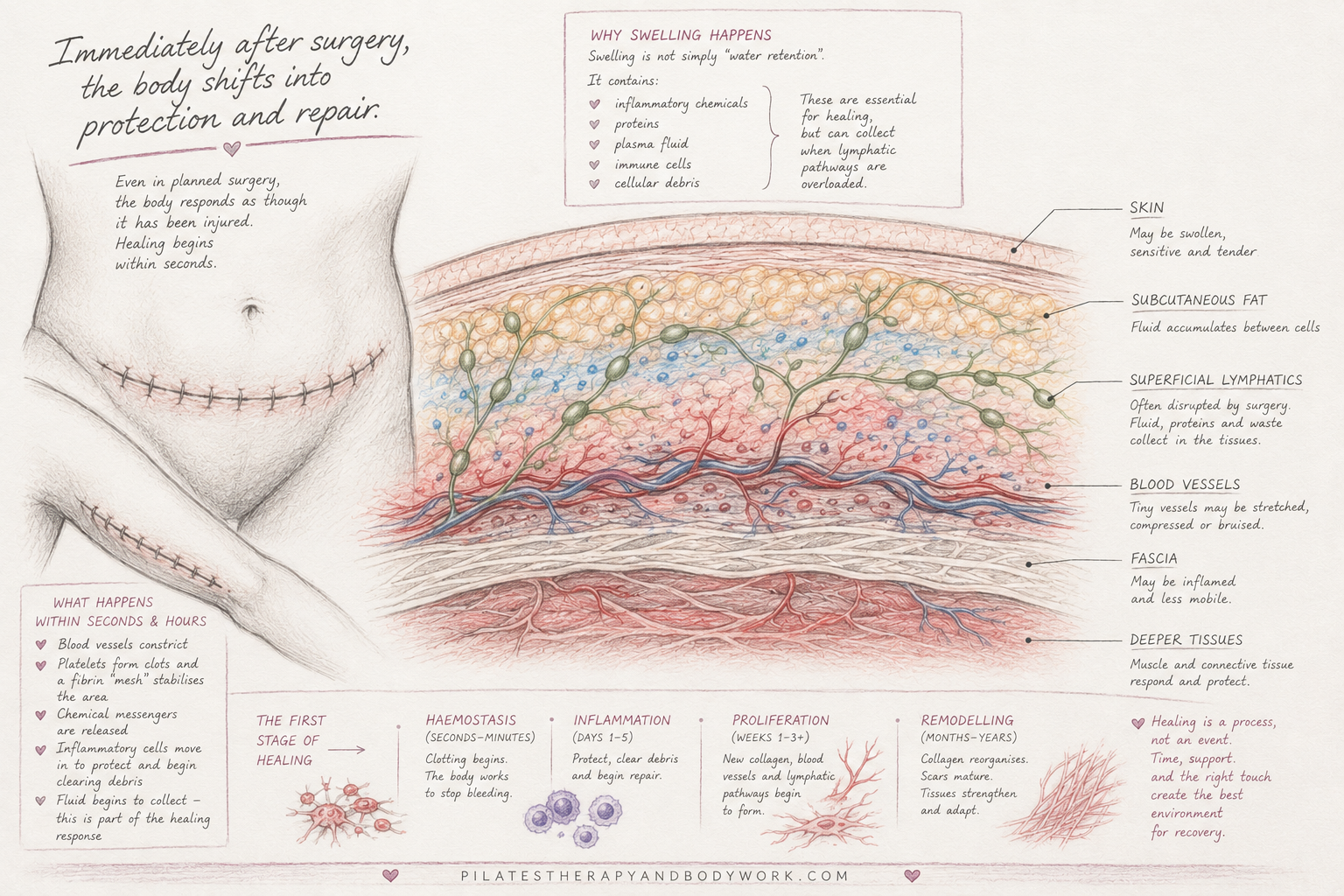
Day One: Your Body Responds As Though It Has Been Injured — Because It Has
Even when surgery is planned and carefully performed, the body still experiences tissue trauma.
Skin, fat, fascia, blood vessels, nerves and lymphatic pathways may all be cut, lifted, stitched, cauterised or repositioned.
Within seconds, the body begins a coordinated healing response.
Research consistently describes wound healing in four overlapping phases:
- haemostasis
- inflammation
- proliferation
- remodelling
Immediately after surgery:
Blood vessels constrict
This helps reduce blood loss.
Platelets begin clot formation
A fibrin mesh develops to stabilise the tissues.
Inflammatory chemicals are released
The immune system activates rapidly.
White blood cells move into the area
The body begins clearing damaged tissue and protecting against infection.
Fluid starts accumulating
This is important.
Post-surgical swelling is not simply “water retention”.
The swelling may contain:
- proteins
- inflammatory chemicals
- plasma fluid
- immune cells
- cellular debris
And because surgery often disrupts lymphatic vessels temporarily, the body’s drainage system may become overloaded.
The First Few Days: Swelling Is Part of Healing
During the first several days after surgery, inflammation becomes much more visible.
People may experience:
- swelling
- bruising
- tightness
- tenderness
- heat
- pressure
- numbness
- heaviness
This stage can feel frightening, particularly when people compare themselves to others online.
But inflammation itself is not the enemy.
Controlled inflammation is essential for repair.
Research into wound healing shows that inflammation is a critical part of tissue regeneration, but excessive mechanical stress or prolonged irritation may negatively influence healing quality.
This is where I think social media can sometimes confuse recovery.
Online groups can be wonderfully supportive, but they can also create pressure to compare:
- swelling
- bruising
- healing speed
- treatments
- “results”
And sometimes more aggressive treatment gets mistaken for better treatment.
But deeper and more painful does not automatically mean more effective.
So Where Does Manual Lymphatic Drainage Fit Into Recovery?
Manual Lymphatic Drainage (MLD) is not deep tissue massage.
Proper Vodder-style MLD uses:
- gentle skin stretch
- rhythm
- direction
- sequencing
- breathing influence
- pressure changes within the body
The superficial lymphatic vessels sit just beneath the skin and respond to light, directional stretch rather than force.
This is why properly applied MLD can sometimes look surprisingly gentle.
Research and clinical guidance consistently describe MLD as a light-touch technique designed to assist lymphatic flow and help reduce oedema.
And importantly:
Gentleness is not “doing nothing”.
Gentleness is often respecting the physiology of healing.
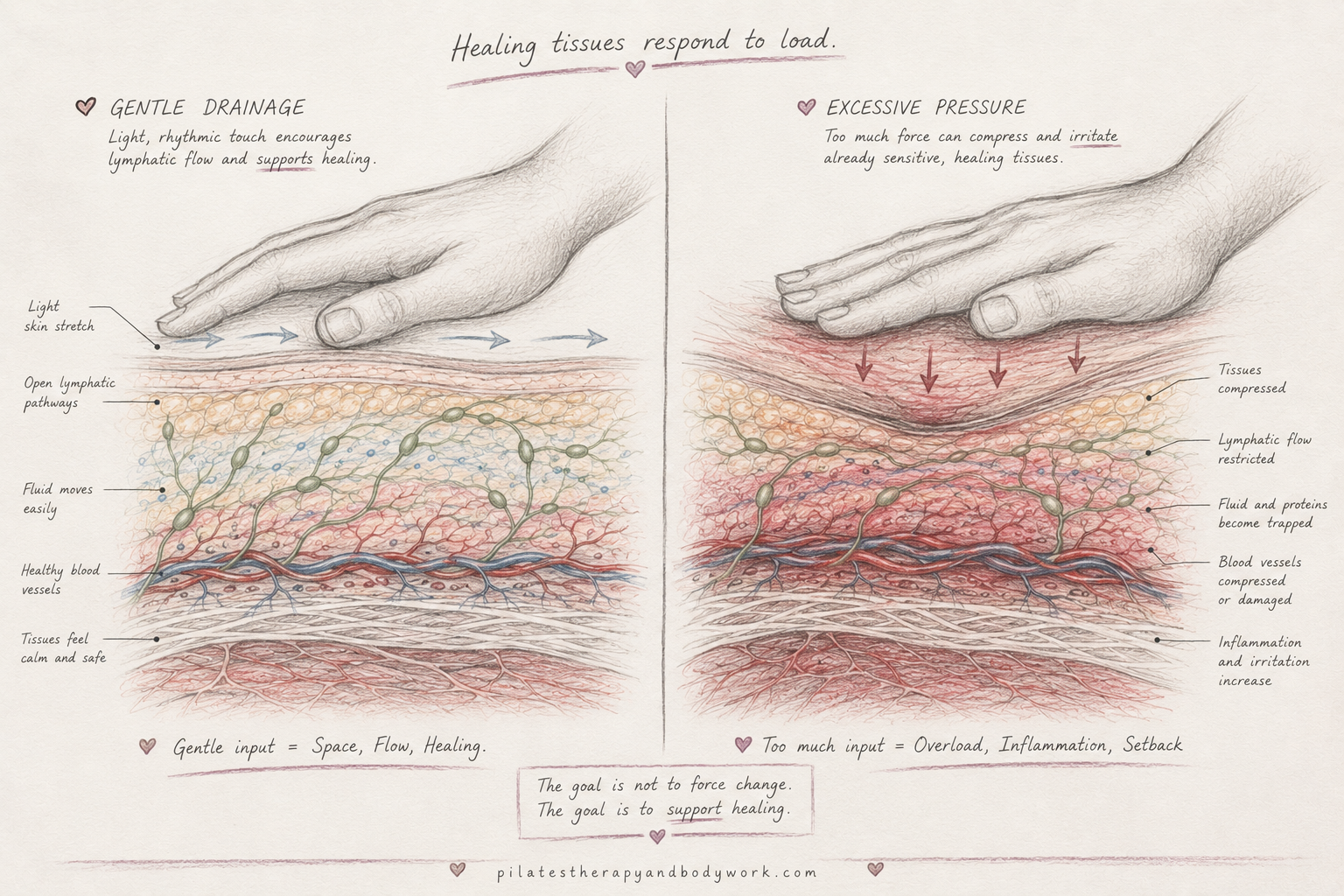
“Gentle drainage vs excessive pressure”
Weeks 1–3: The Body Starts Rebuilding
This is often where confusion begins.
From the outside, people may look “better”.
But internally, healing is still extremely active.
During the proliferative phase:
- collagen production increases
- fragile new blood vessels form
- lymphatic rerouting begins
- tissues reconnect
- early scar tissue develops
This phase may continue for several weeks.
And this matters because healing tissues are mechanically sensitive.
Research into wound healing and tissue remodelling shows that tissues respond to loading forces during repair, and excessive stress may contribute to prolonged inflammation and fibrosis.
So when somebody says:
“The treatment was really deep and painful — I bruised afterwards.”
…my clinical thought is not:
“That must have worked well.”
My thought is:
“Were the tissues actually ready for that level of force?”
Bruising means small blood vessels have been damaged.
In already inflamed tissues, that may not create the best healing environment.
Scar Tissue Does Not Finish Healing When The Wound Closes
This is one of the biggest misunderstandings in recovery.
People often assume:
“The scar has healed.”
But scar remodelling may continue for:
- 12 months
- 18 months
- sometimes up to 2 years
During this time:
- collagen reorganises
- tissue tension changes
- scars soften
- fibrosis may develop
- movement patterns adapt
This is why timing matters.
Early post-surgical drainage work is not the same thing as aggressive scar treatment later in recovery.
Different tissues.
Different goals.
Different stages.
Breathing, Pressure and Swelling Are Connected
After abdominal surgery especially, people often stop moving and breathing normally.
They may:
- brace their abdomen
- breathe shallowly
- avoid rib expansion
- hold tension
- fear movement
- change posture
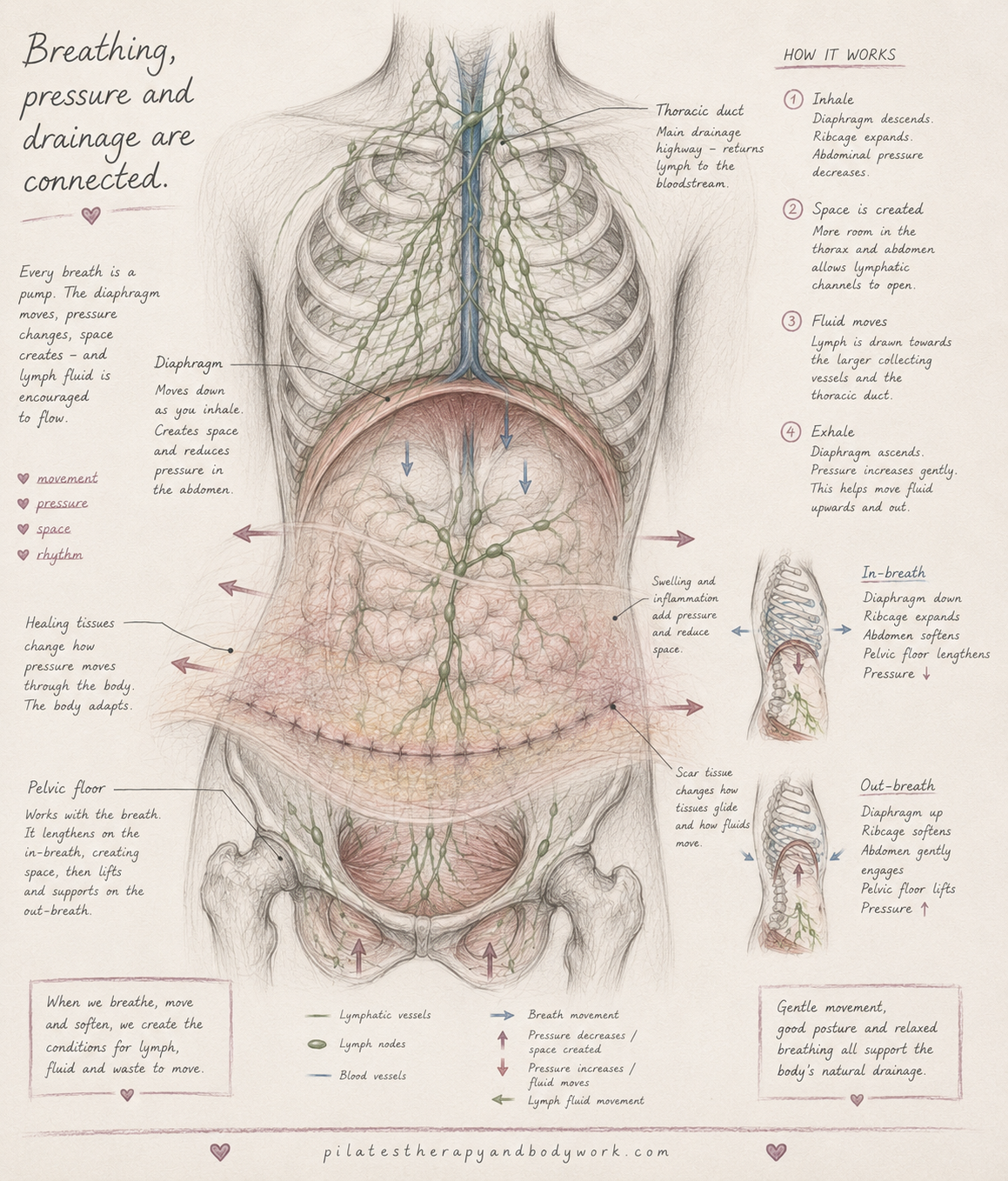
This changes pressure inside the body.
The diaphragm plays a huge role in:
- venous return
- lymphatic flow
- abdominal pressure regulation
- movement of fluid through the trunk
Sometimes one of the most helpful things we can do early in recovery is help the body feel safe enough to:
- breathe
- soften
- rotate
- walk
- move fluid naturally again
“Breathing, pressure and drainage are connected”
Why Home Care Often Matters More Than One Big Treatment
One treatment is rarely the entire answer.
Recovery usually responds better to:
- consistency
- rhythm
- repetition
- gentle movement
- breathing
- pacing
- small regular inputs
This is why I often teach clients:
- short breathing work
- simple self-drainage
- positioning advice
- gentle walking
- calming the nervous system
- awareness of overload
Not hour-long complicated routines.
Just small things repeated regularly.
Because healing tissues often respond better to support than force.
My Thoughts As a Therapist
I completely understand why people assume stronger treatment must mean better treatment.
But once we understand:
- inflammation
- lymphatics
- scar formation
- tissue remodelling
- pressure systems
- healing timelines
…gentleness starts making a lot more sense.
The goal is not to “attack” swelling.
The goal is to support the body while it is trying to rebuild itself.
And in my opinion, informed by both clinical experience and healing research, respecting tissue physiology early on may help create a calmer environment for long-term recovery.
When To Seek Medical Advice
Manual Lymphatic Drainage should always sit alongside medical care, not replace it.
Seek advice from your surgeon or medical team if you notice:
- increasing redness
- heat
- fever
- severe pain
- unusual swelling
- calf pain
- shortness of breath
- wound opening
- discharge
- signs of infection
MLD is not appropriate in every situation and should only be performed when medically appropriate.
Gentle Post-Surgical Support
I offer gentle, clinically informed Manual Lymphatic Drainage and scar-aware bodywork in Clacton-on-Sea, Bury St Edmunds, Essex and Suffolk.
My approach is calm, evidence-informed and focused on supporting healing — not forcing it.
You can find more information here:
- What Is Manual Lymphatic Drainage?
- Scar Therapy and Healing
- Does an immediate result always mean better healing?