
“I just don’t feel like myself anymore…”
This is something I hear a lot — although not always said out loud.
It might come through as:
- “I get tired so quickly now”
- “My legs feel weaker”
- “Everything just feels harder than it used to”
Or sometimes just:
“Something’s changed… and I can’t quite explain it.”
And the truth is — something has changed.
In the UK:
- 1 in 8 men will be diagnosed with prostate cancer
- Over 64,000 men are diagnosed every year
- Around 540,000 men are living with or beyond prostate cancer
(Prostate Cancer UK)
So if this is how you’re feeling…. you are not alone.
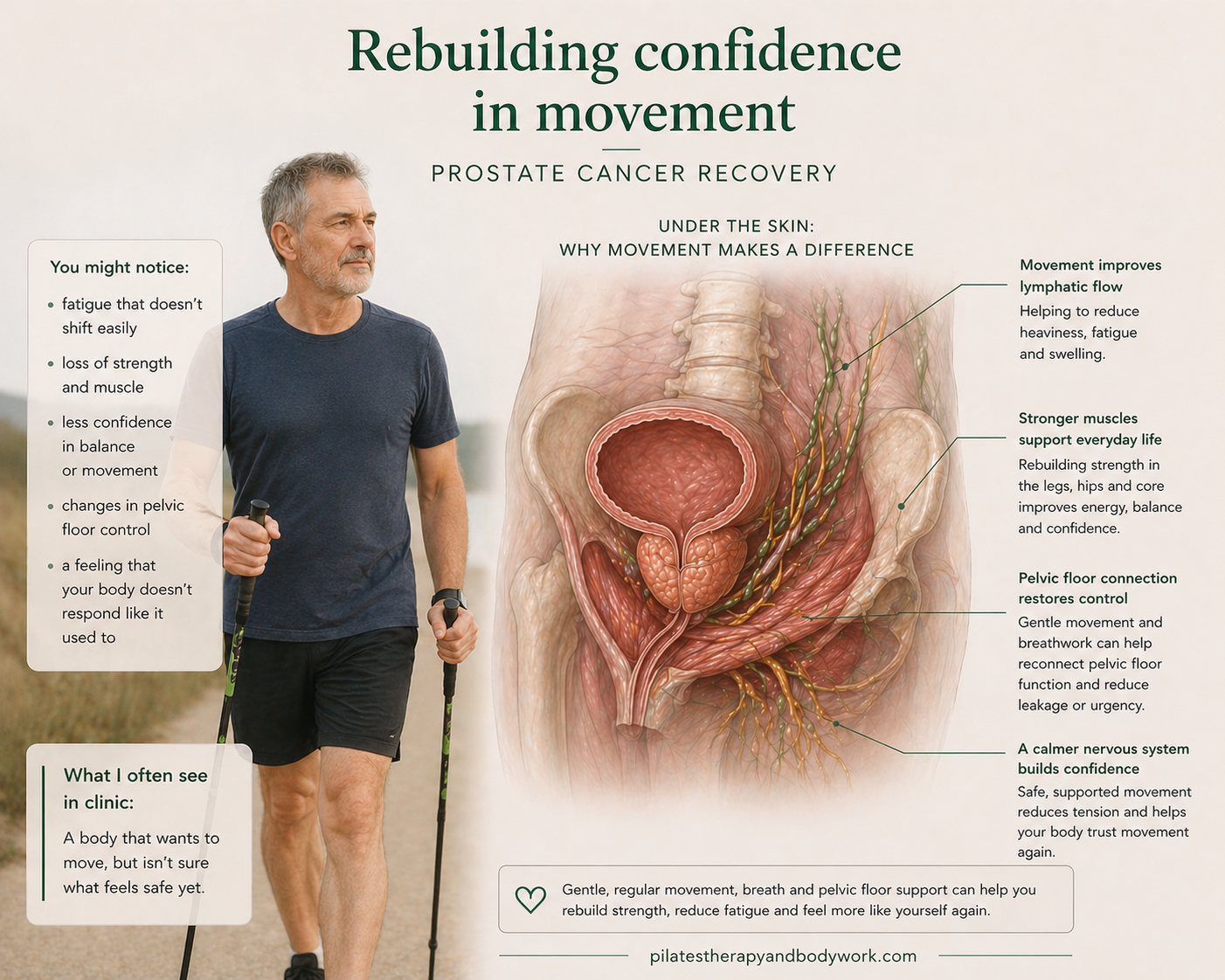
What you might notice
It doesn’t always look dramatic.
But it can feel like:
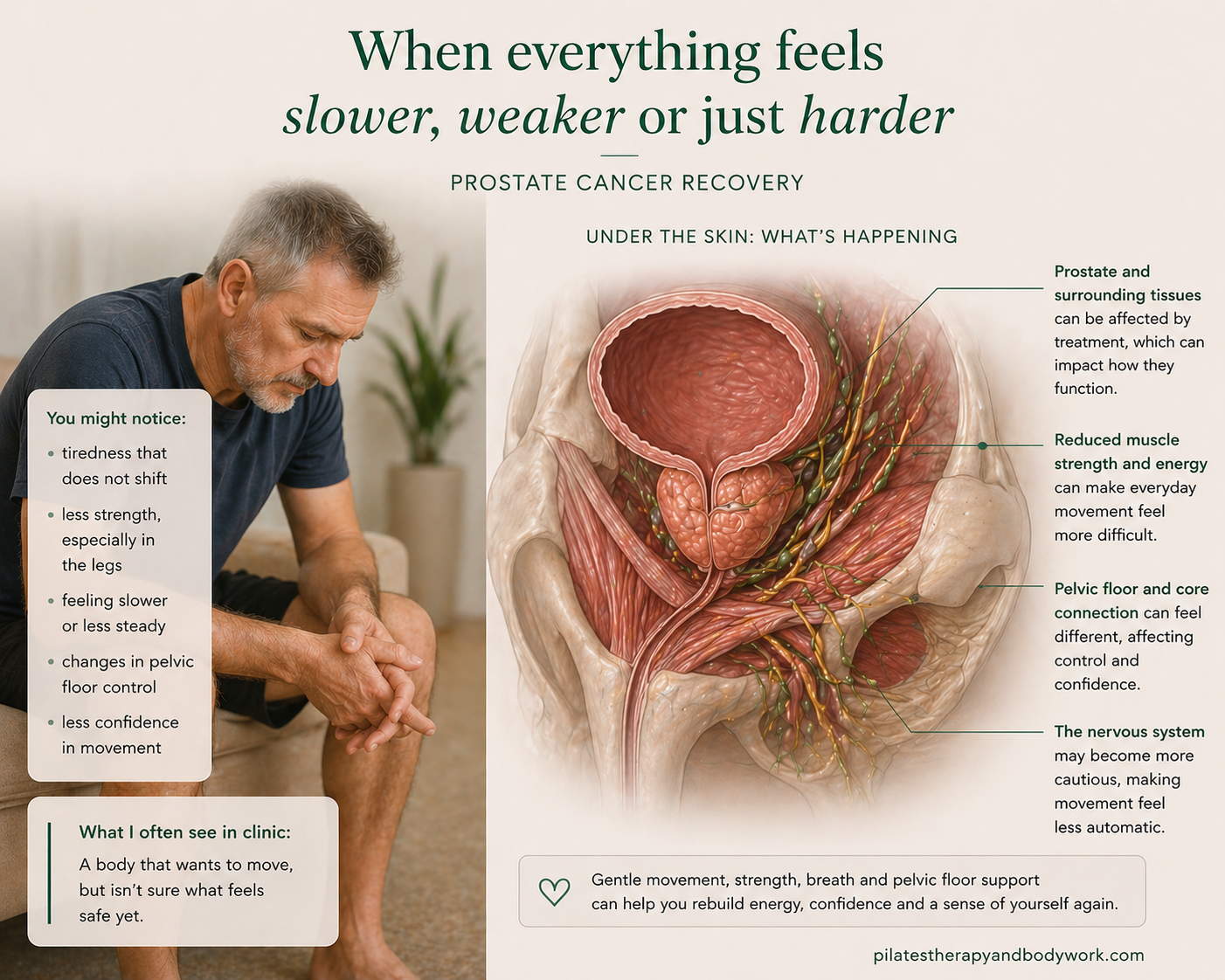
- A deep fatigue that doesn’t shift easily
- Loss of strength, especially in the legs
- Feeling slower, less steady, less confident
- A sense that your body just doesn’t respond the same way
And for many men:
- Changes in pelvic floor control
- A quiet hesitation to move “just in case”
What’s happening underneath
Fatigue is real (and very common)
Cancer-related fatigue is different to normal tiredness.
- It doesn’t always improve with rest
- It can feel unpredictable
- It’s one of the most commonly reported symptoms after prostate cancer
Research suggests fatigue can affect up to 80% of men, depending on treatment.
Hormone therapy and muscle changes
Treatments can:
- Reduce testosterone
- Lead to loss of muscle mass and strength
- Increase fatigue
So this isn’t “just ageing”
• it’s a real physiological shift.
Movement, circulation and lymphatic flow
When activity drops:
- Circulation slows
- Lymphatic flow becomes less efficient
- The body can feel heavier, slower, more effortful
Your system relies on movement to keep things flowing.
The nervous system (the missing piece)
After treatment:
- The body can feel more cautious
- Movement less automatic
- Confidence can dip
So it’s not just physical.
• It’s about how safe your body feels to move.
Pelvic floor changes (and why they matter more than people realise)
This is often the part that isn’t talked about enough.
After prostate cancer treatment — especially surgery — pelvic floor changes are very common.
You might notice:
- leaking when moving, coughing or getting up
- urgency or reduced control
- a feeling that things just don’t respond the same way
- holding back from movement because you’re unsure
How common is it?
- Up to 80–90% of men experience urinary incontinence immediately after prostate surgery
- Around 10–20% continue to have longer-term symptoms
(NHS, NICE, Prostate Cancer UK)
Radiotherapy can also affect:
- bladder sensitivity
- urgency
- control over time
What’s actually happening?
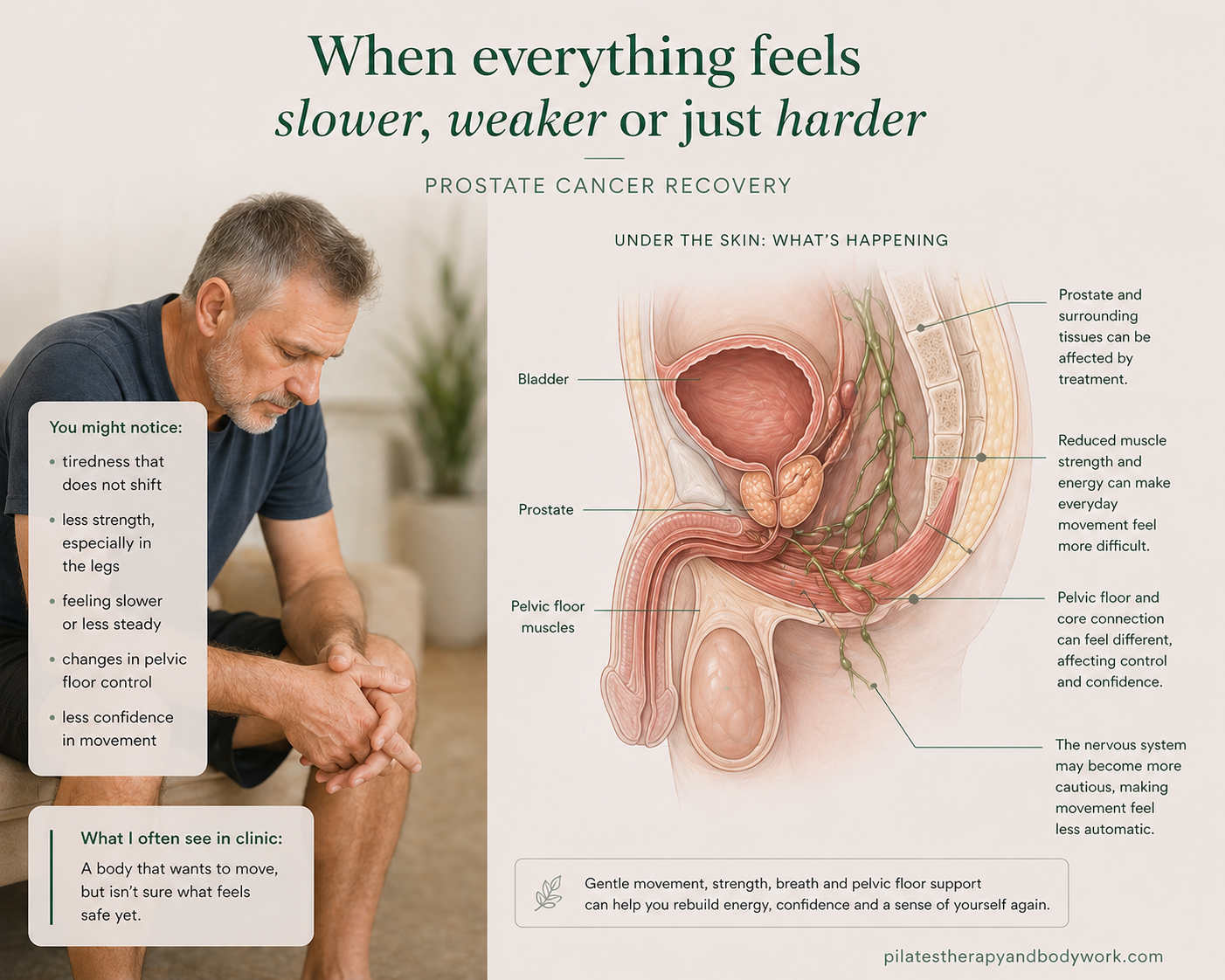
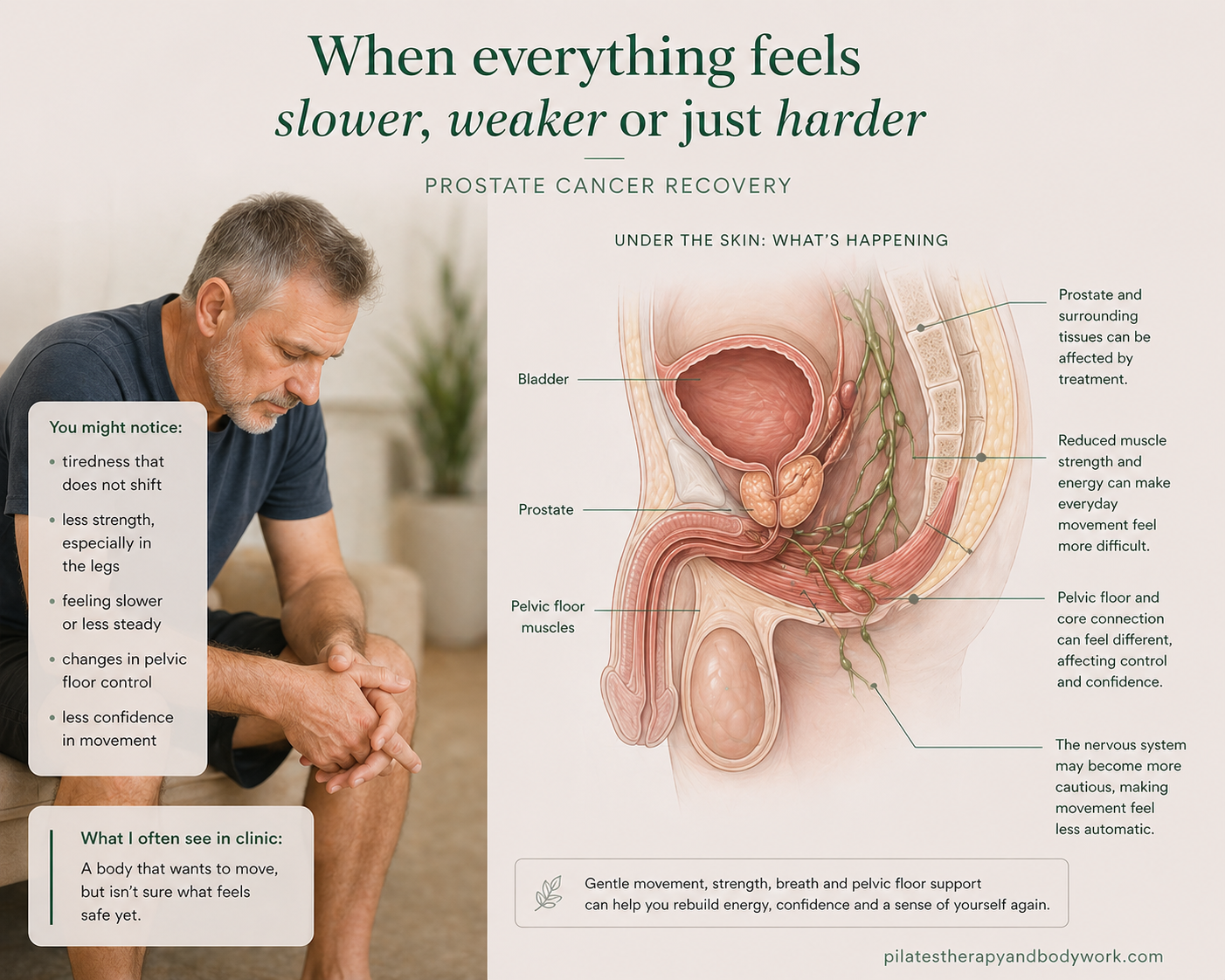
The pelvic floor:
- supports the bladder
- controls continence
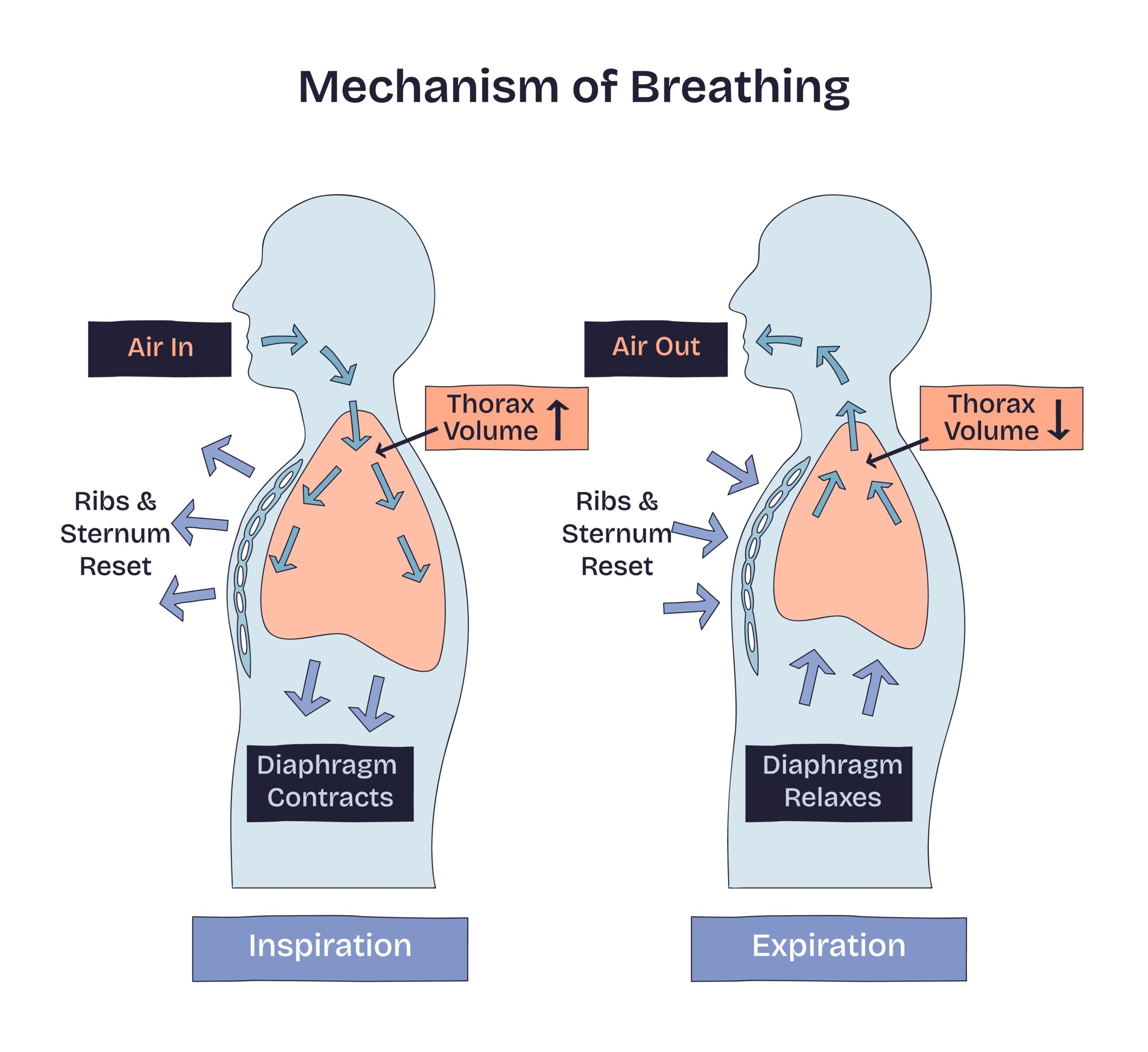
- works closely with breath and core
After treatment:
- strength and coordination can change
- the connection between brain and movement can feel disrupted
And importantly:
– confidence often drops before strength fully returns
The role of pelvic floor exercises (and why they’re worth doing)
Pelvic floor exercises are one of the most effective ways to support recovery.
What the evidence shows
- Men who do pelvic floor muscle training recover continence faster
- Starting before and continuing after treatment improves outcomes
- Regular practice reduces long-term symptoms
(NICE guidance; Cochrane reviews; Prostate Cancer UK)
But in real life…
It’s not just about squeezing muscles.
It’s about:
- learning how to feel the pelvic floor
- coordinating it with breath and movement
- rebuilding trust in how your body responds
Because:
– A muscle you don’t trust still limits how you move
Why movement matters (and why it’s often avoided)
It’s completely understandable to:
- rest more
- do less
- wait until things feel better
But:
– Movement is part of what helps things improve
UK guidance supports this:
- It is safe to be active during and after treatment
- Even 10–15 minutes to start with can help
- Gradual progression improves outcomes
Exercise, recovery and the bigger picture
Research shows that physical activity after prostate cancer:
- improves fatigue, strength and quality of life
- supports long-term health
- may be linked to reduced risk of cancer progression and mortality
(Macmillan, ACSM, Bourke et al.)
– Movement is not just safe — it’s protective.
What helps (in real life, not theory)
Gentle, progressive movement
- Walking
- Light strength work
- Reintroducing rhythm
Supported walking (WALX)
WALX can help by:
- encouraging natural movement
- supporting posture
- building confidence
Not fitness.
• Just a way back in.
Pelvic floor + breath connection
Small changes here:
- improve control
- support movement
- rebuild confidence
What support can look like
It might be:
- 1:1 sessions
- rehab groups
- walking-based support
- or simply understanding your body again
Often, when pelvic floor confidence improves:
– everything else starts to follow
What I often see in clinic
A body that wants to move…
but isn’t quite sure what feels safe yet.
And once we start gently:
- strength builds
- movement improves
- confidence returns
If everything feels slower, weaker or harder…
That doesn’t mean you’ve lost what you had.
It usually means:
• your body is adapting
• your system needs support
• you need a way back in that feels manageable
If this sounds familiar, you’re not alone.
I support clients in Clacton-on-Sea and Bury St Edmunds (Essex & Suffolk) with:
- specialist movement and rehab
- pelvic floor and breath support
- WALX (supported walking)
- and gentle return to activity
You don’t need to push through.
There’s a way to rebuild — step by step.