Has Anyone Asked the Right Questions?
Weight loss, exercise, bodywork and medical history. Are we joining the dots before we start?
I’ve been down another of my rabbit holes.
It started with a conversation about losing weight, muscle mass and bone health. And then I found myself wondering about something much bigger.
We encourage people to lose weight when appropriate, move more, build strength, exercise for their health, look after themselves and seek treatments that might help them feel better.
And quite rightly so.
But here’s my question.
Before someone joins a weight-loss programme, starts an exercise class or books a bodywork treatment, how do we know that what we’re offering is right for them?
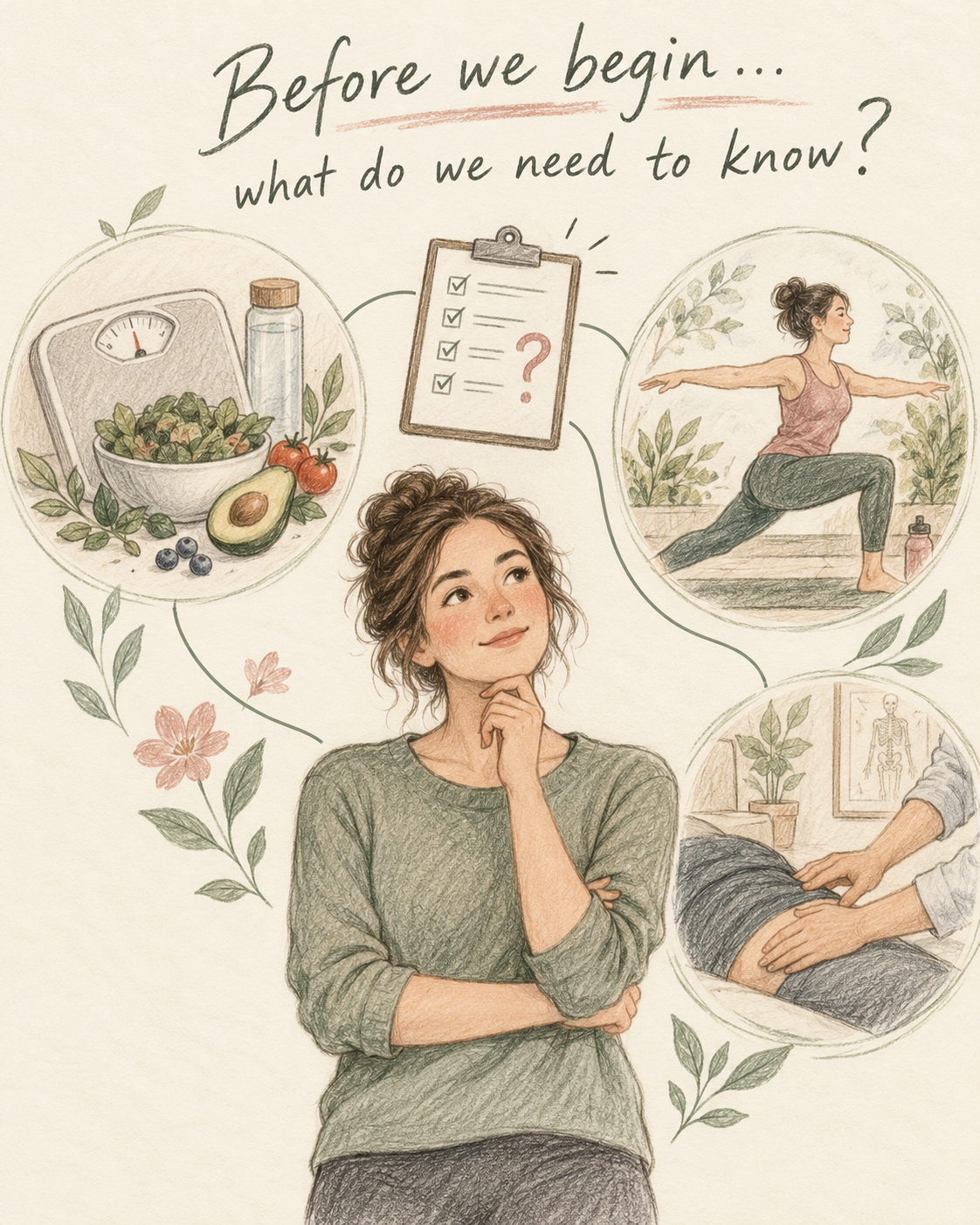
And perhaps just as importantly, who is responsible for asking the questions?
Because someone might arrive wanting to lose a stone, improve their fitness or get some help with swollen legs.
But they don’t arrive as just a number on the scales, a pair of swollen ankles or a tight shoulder.
They arrive with a history.
There might have been cancer treatment, surgery, osteoporosis, diabetes, medications, lymph node removal, neuropathy or years of managing more than one health condition.
Sometimes the person doesn’t realise that something in their medical history might matter.
Sometimes the person offering the service might not realise either.
And sometimes we all assume somebody else has already asked.
What does screening actually mean?
I don’t think screening should be about making people jump through hoops.
And I certainly don’t think everyone needs a GP appointment before joining an exercise class, trying to lose weight or having a massage.
That isn’t what UK guidance says.
For me, screening is about gathering enough information to make an informed decision.
Can we proceed? Do we need to adapt? Is there something we don’t understand?
Or is there a question that needs answering by somebody with different expertise?
It may involve a questionnaire, a conversation, physical assessment, reviewing medical information or asking for clarification.
But I think there’s a difference between collecting information and actually understanding what it means.
Is a wellness questionnaire the same as health screening?
This is where my original question started taking me somewhere else.
When somebody joins a weight-loss programme, they might be asked about their weight, measurements, eating habits, water intake, activity levels and goals.
All useful information.
An exercise instructor might ask about fitness and previous experience.
A therapist might ask what treatment someone wants.
But does that mean the person has been appropriately screened?
Not necessarily.
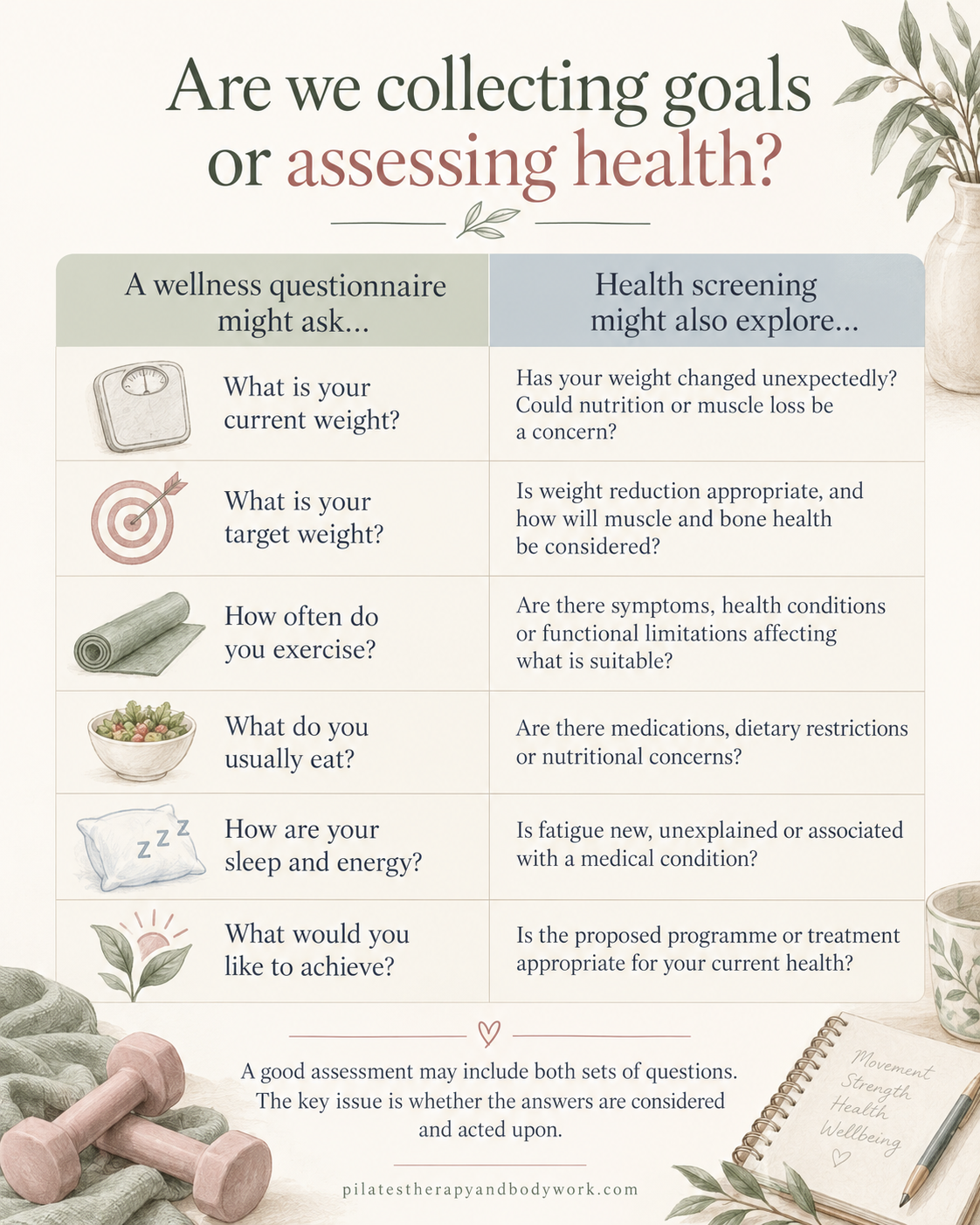
What happens if someone has osteoporosis, has previously received chemotherapy, takes medication for diabetes, or has three or four conditions all interacting?
Has anybody asked?
And if they have asked, do they understand what the answers mean?
A form might establish what someone wants to achieve. A proper screening process should also identify whether anything about their health changes how we help them achieve it.
And that’s the bit I keep coming back to.
Completing a questionnaire isn’t necessarily the same as being screened appropriately.
If a medical condition is identified, what happens next?
Does someone ask further questions, adapt the programme or recognise when further advice is needed?
Or does everyone follow much the same plan?
What do UK guidelines actually say?
This is important because I don’t want people thinking that having a medical condition means they cannot make positive changes.
The NHS and NICE encourage appropriate weight management, exercise and physical activity, including for people living with long-term conditions.
But they also recognise that the approach may need to be individualised.
NICE guideline NG246, updated in 2025, specifically considers existing medical conditions, personal circumstances, nutritional balance and the need for clinical support with more restrictive dietary interventions.
For example, diets providing 800–1,200 calories a day are recommended only within an appropriate specialist or long-term-condition management service as part of a wider supported approach for eligible adults.
Diets providing fewer than 800 calories require specialist obesity-service oversight and a clinically assessed reason for rapid weight reduction.
Both require nutritional completeness, clinical supervision and longer-term support, with a maximum recommended duration of 12 weeks.
That is rather different from simply telling someone to eat less.
And what about exercise?
Most people with osteoporosis can and should remain active. But someone with spinal fractures may need a very different programme from someone with no history of fractures.
Someone recovering from cancer may benefit enormously from exercise, but bone involvement, treatment-related neuropathy, fatigue or other complications may change what is appropriate.
The point isn’t to stop people.
It’s to get the starting point right.
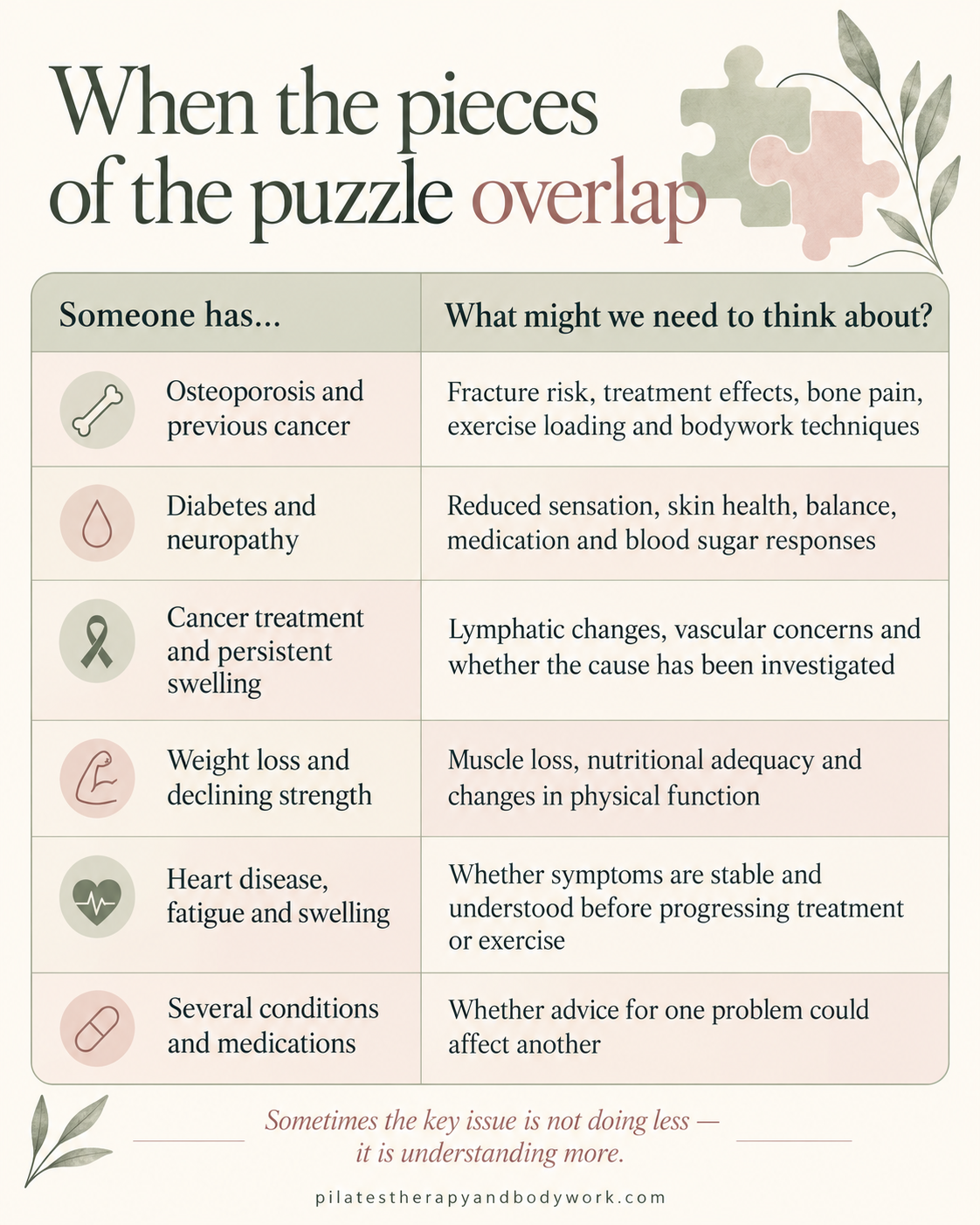
But what if someone has more than one medical condition?
This is where it starts to get interesting.
Someone might have osteoporosis and a history of breast cancer treatment.
Someone else may have diabetes, neuropathy and poor balance.
Another person may have heart disease, medication-related concerns and swollen legs.
Each condition might have its own guidance.
But what happens when they overlap?
NICE has a whole guideline, NG56, about multimorbidity — the management of people living with multiple long-term conditions.
It recognises that treatment recommendations designed for one condition may need to be reconsidered when someone has several conditions, multiple medications and different priorities.
That sounds rather familiar to me.
Because sometimes we’re so focused on treating the thing in front of us that we forget to ask what else might be influencing it.
And sometimes it’s not a question of doing something differently.
Sometimes it’s recognising that we need more information.
Can someone lose weight and become less healthy?
Yes, it is possible.
And this was actually the question that started my original rabbit hole.
We tend to celebrate weight loss.
The scales go down, clothes fit differently, people offer congratulations.
But what exactly has been lost?
Fat? Muscle? Water? Perhaps some of each?
Weight reduction can improve metabolic health, mobility and many obesity-related conditions.
But muscle and bone deserve some attention too, especially as we get older.
A study published in the New England Journal of Medicine in 2011 followed 107 adults aged 65 and over with obesity, comparing dietary weight loss, exercise, a combination of both and a control group.
The diet-only group lost around 10% of their body weight over 12 months.
But they also lost approximately 5% of their lean mass and 3% of their hip bone mineral density.
The group combining weight loss with exercise lost a similar amount of weight, but their losses of lean mass and hip bone density were smaller — approximately 3% and 1% respectively.
Their physical function improved more too.
That doesn’t mean everyone who loses weight will lose the same amount of muscle or bone. The trial involved a particular group of older adults.
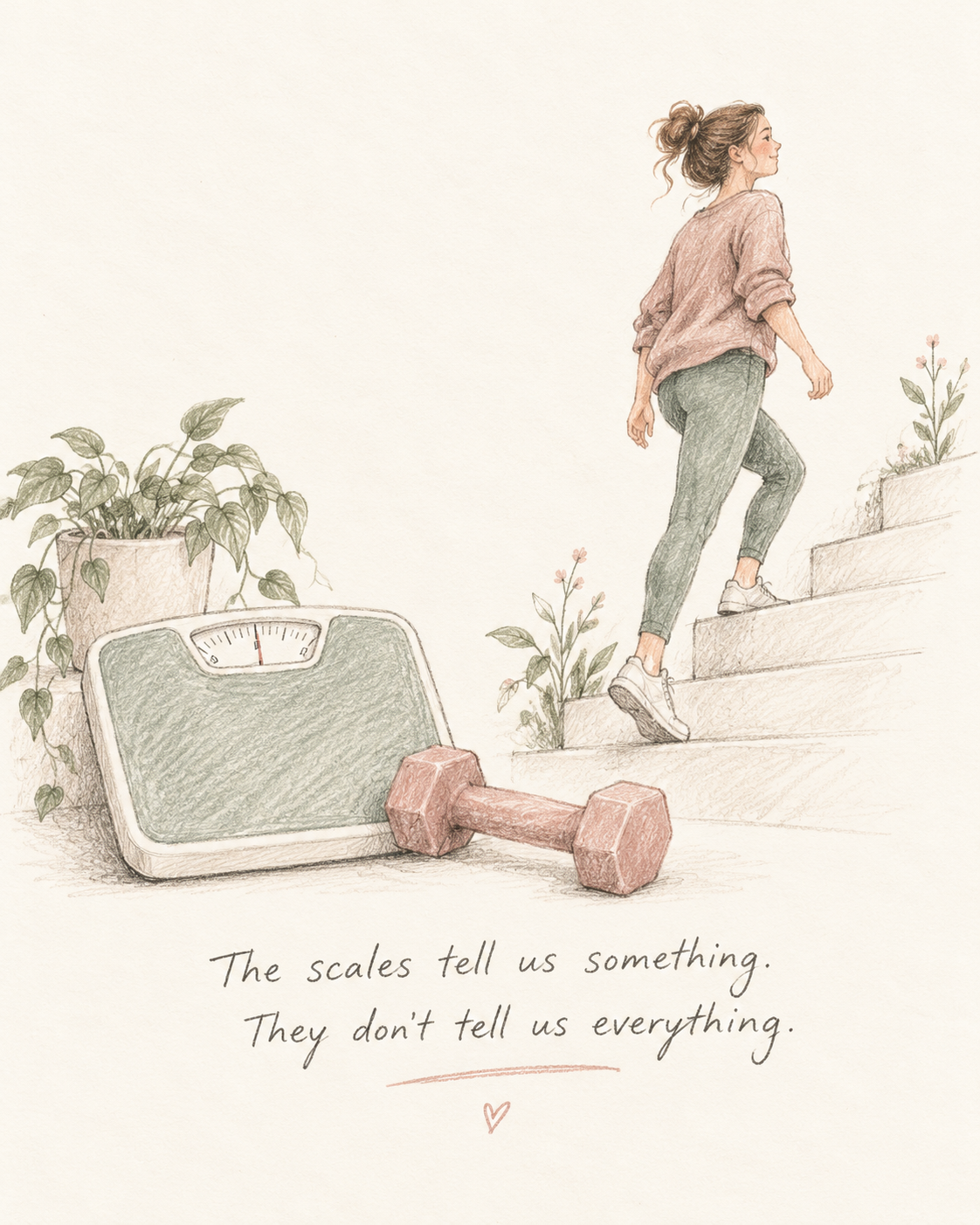
But it demonstrates why how we lose weight matters as well as how much we lose.
And perhaps we should be celebrating someone getting stronger, walking further, feeling steadier on their feet or managing the stairs more easily, alongside changes on the scales.
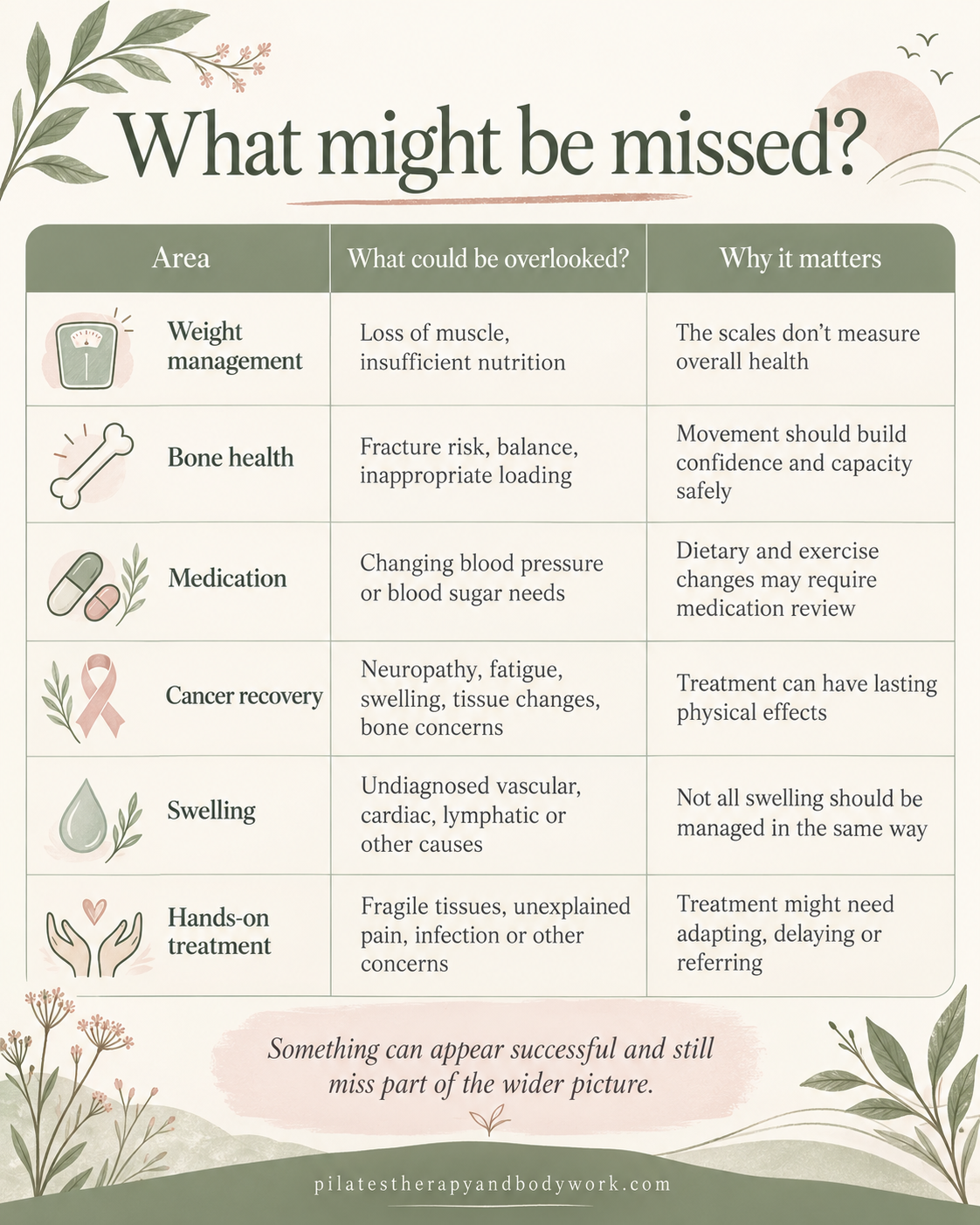
What else could we be overlooking?
And this doesn’t just apply to weight loss.
A person may improve in one area whilst something else needs attention.
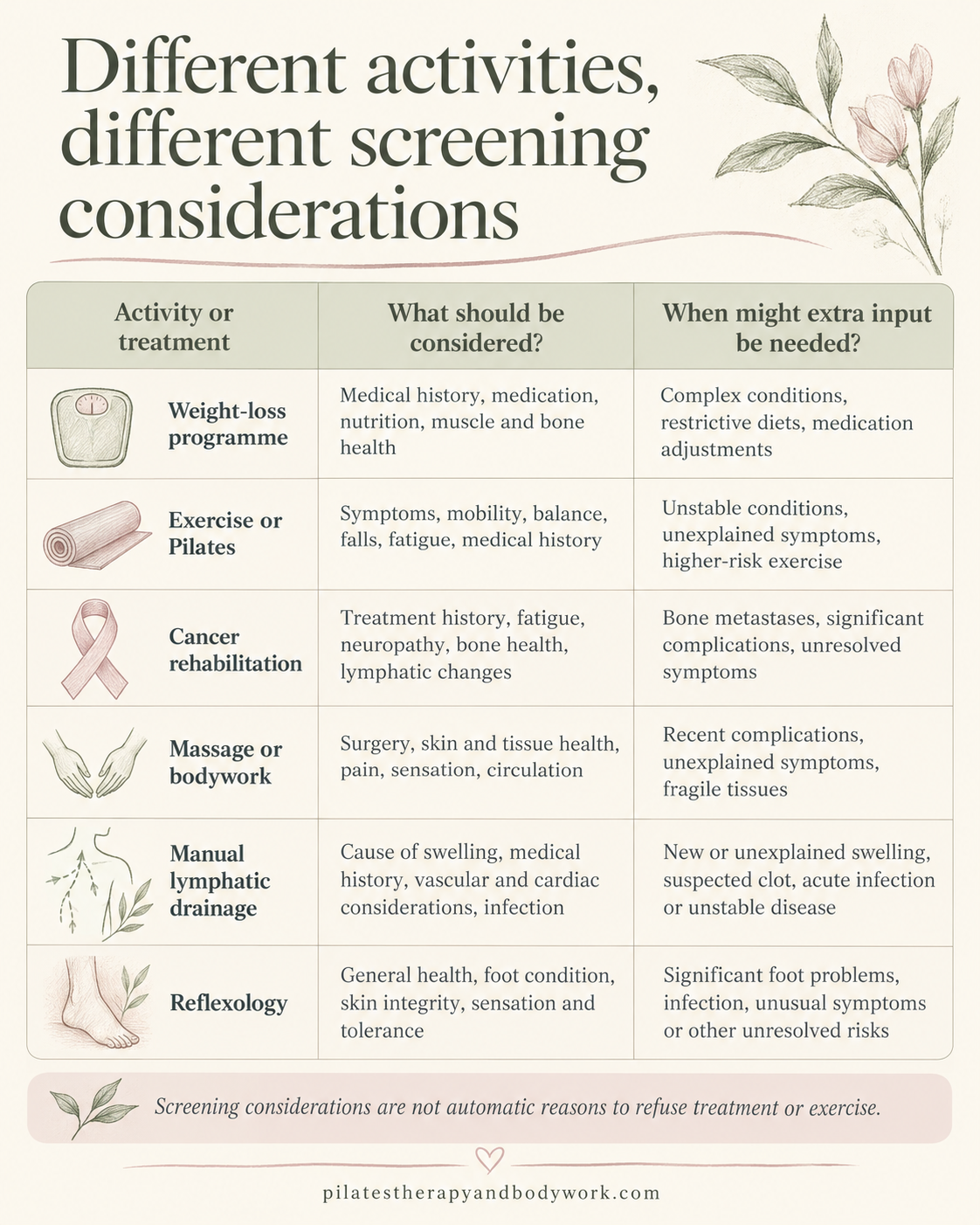
I think this table is quite revealing.
Not because we should all be looking for things to go wrong.
But because there’s a difference between something appearing successful and it being appropriate for the whole person.
And that’s something both the public and practitioners need to understand.
So how do you know if you’ve been screened appropriately?
I’ve put together two simple traffic-light guides.
One for the person attending a class, programme or treatment.
And another for the professional providing it.
These are educational guides, not validated clinical screening tools. They help us think about the process, rather than diagnose a condition.
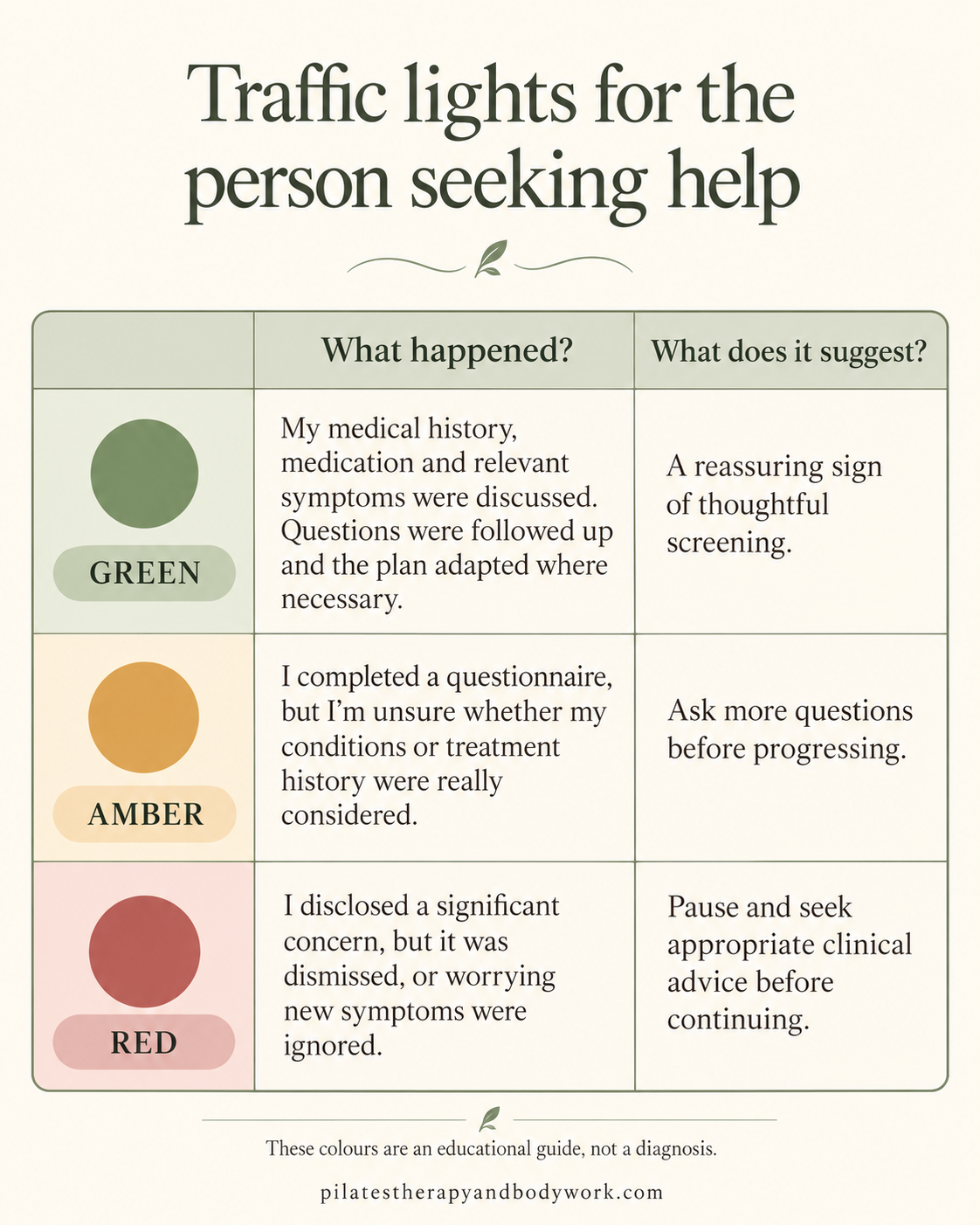
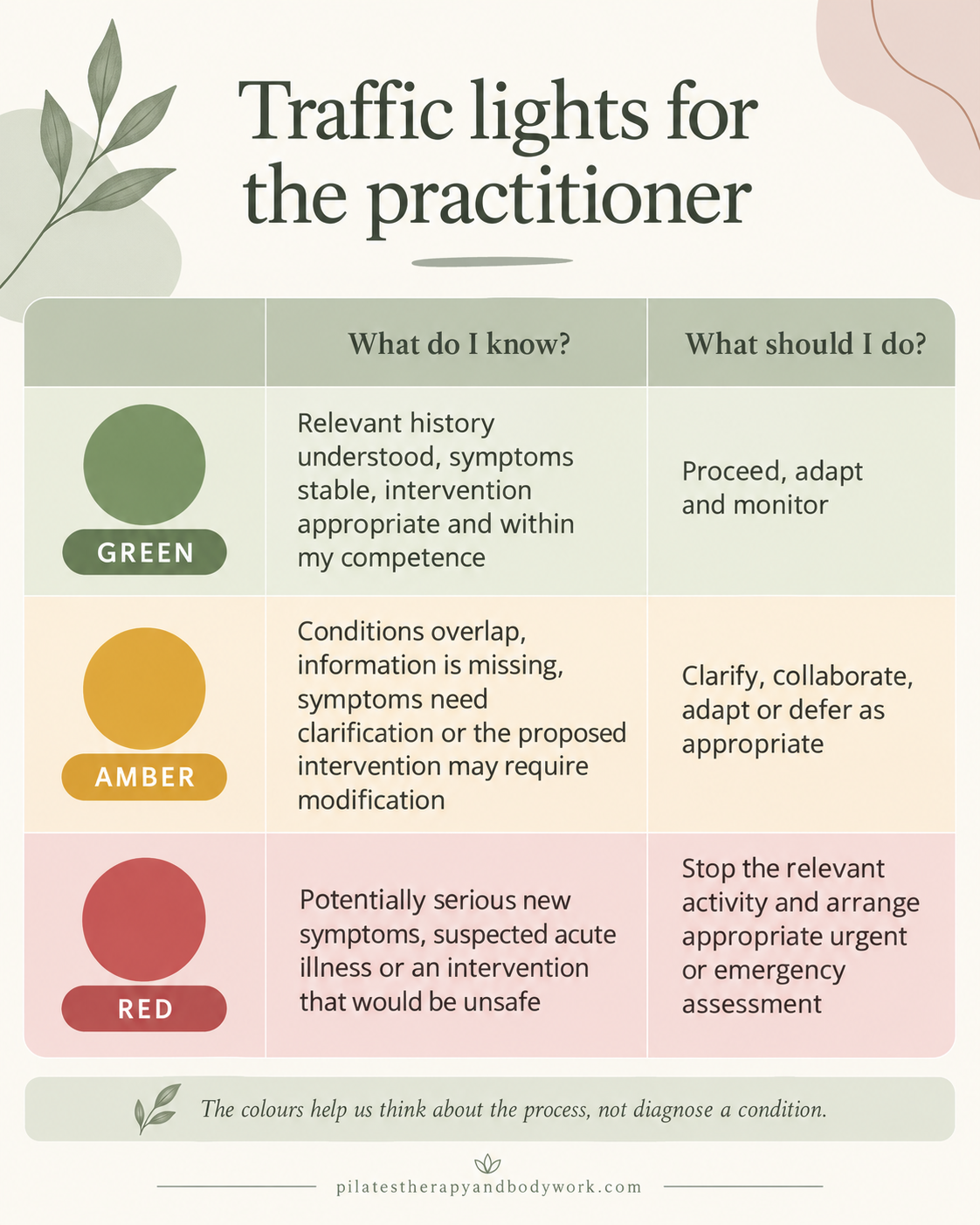
The colours are not diagnoses. A green screening conversation cannot guarantee safety, and having several medical conditions does not automatically put someone in the red category.
New chest pain with concerning symptoms, severe breathing difficulties or signs of stroke warrant emergency help through 999. Other new or worrying symptoms may require urgent assessment through NHS 111, a GP or the relevant clinical team.
I think these are useful not only for people wanting to know if they have been properly assessed, but also as a little reminder for those of us providing the services.
Because sometimes we become so familiar with what we do that it’s worth revisiting what we’re asking.
Does the GP need to give permission?
Now this is another area where I think we can get ourselves into a muddle.
Not everybody needs a GP to sign a form before exercising, dieting or receiving treatment.
And a GP cannot reasonably be expected to understand every specialist technique used by every practitioner.
But sometimes we need medical clarification.
And perhaps we should be asking a more specific question rather than simply requesting permission.
For example, if I assess somebody with persistent swelling, I might feel that manual lymphatic drainage could be beneficial.
But if the cause of the swelling is unclear, or I think compression needs to be considered, then there may be other medical questions that need answering.
Has the swelling been investigated?
Are there cardiac or vascular considerations?
Would further assessment or compression advice be appropriate?
That’s a much more useful conversation than simply asking somebody to approve a treatment.
Equally, an exercise professional working with someone with osteoporosis and new back pain may need clarification about a possible fracture before progressing certain movements.
And a weight-management provider working with someone taking diabetes medication may need the prescribing clinician involved when dietary intake changes substantially.
Good collaboration isn’t passing responsibility to somebody else. It’s recognising when a piece of information is missing and involving the right person to help find it.
Of course, that requires permission from the person concerned and appropriate sharing of relevant information.
And we should remember that sometimes the right person isn’t the GP. It might be a physiotherapist, registered dietitian, pharmacist, oncology team, lymphoedema specialist or another appropriate healthcare professional.
Is screening a one-off exercise?
I don’t think it should be.
Someone might begin a programme with everything stable and well understood.
Then medication changes.
They have surgery.
A new symptom develops.
They become unwell.
Their mobility or strength changes.
Or they receive a new diagnosis.
What was appropriate three months ago may need reconsidering today.
And screening should be an ongoing conversation, not just a document completed at the first appointment and never looked at again.
How many people actually know they should be asking these questions?
This is something I went looking for in the research.
I wanted to know how many people understand that their medical history may influence their choice of weight-loss programme, exercise or hands-on treatment.
And how often screening is missed.
I couldn’t find robust UK-wide figures answering those questions directly.
There is research into people’s understanding of weight-related health risks, and into the benefits and potential adverse effects of different interventions.
But that isn’t the same as knowing how many people have received appropriate medical screening.
And I think that is an interesting gap in itself.
We spend a great deal of time encouraging people to improve their health.
But how much time do we spend helping them understand what good, individualised support should look like?
Perhaps we need to ask better questions?
If you’re looking to start something new, it is reasonable to ask the person offering the service:
-
Have you considered my medical history?
-
Is this appropriate for me?
-
Is there anything we should adapt?
-
Would it help to speak to my GP or another professional?
-
What should we look out for as we go along?
And if you’re the practitioner, perhaps ask yourself:
-
Have I asked enough?
-
Do I understand the answers?
-
Am I working within my knowledge and competence?
-
Have I assumed somebody else has checked something?
-
Would another professional’s input help?
-
Do I need to reassess before we continue?
These aren’t difficult questions.
But sometimes they make all the difference.
Are we joining the dots?
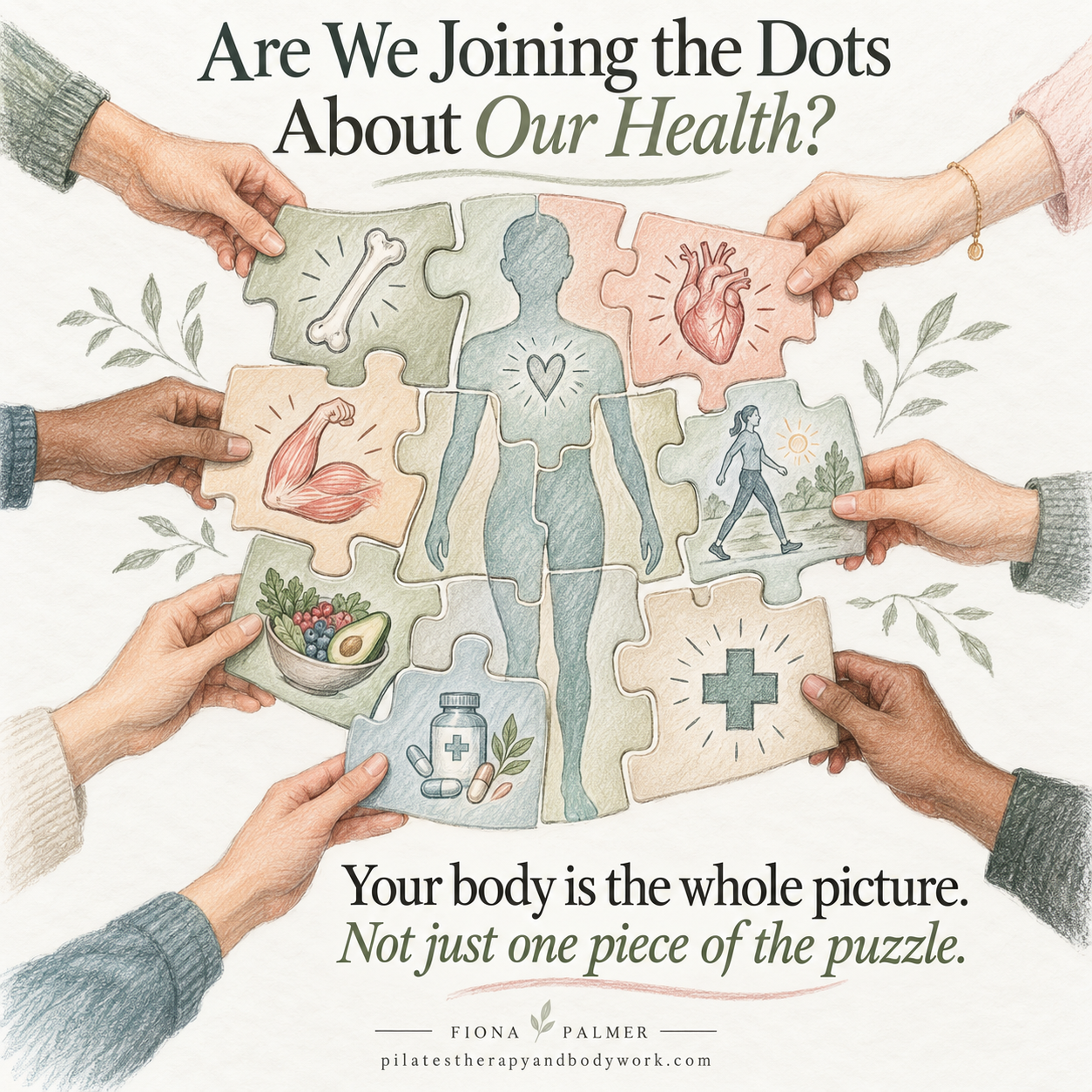
The longer I work with people, the more I appreciate that our bodies don’t operate as separate departments.
Nutrition affects muscle.
Muscle affects movement.
Movement affects bone health, circulation, confidence and independence.
Medication, surgery, cancer treatment, long-term conditions and recovery can influence all of those things.
And sometimes a change that benefits one part of someone’s health needs to be balanced against what it means for another.
This isn’t about suggesting that weight-loss coaches, exercise professionals or bodywork therapists should become medical experts.
Quite the opposite.
It’s about having enough knowledge to recognise what we can help with, what we need to adapt and what might benefit from another professional’s input.
Nor should we make screening so complicated that people become frightened to do anything.
We need people to move, build strength, access support and feel confident about looking after themselves.
But we also need to understand the person, not just the programme or treatment.
I keep coming back to where this all started.
Before we congratulate someone on how much weight they’ve lost, have we considered what else they might have lost along the way?
And before we celebrate somebody starting a new exercise programme or receiving treatment, have we thought enough about whether it is right for them?
Perhaps better screening, better conversations and a little more professional collaboration would help us join some of those dots.
Because sometimes good care doesn’t begin with the treatment.
It begins with asking the right questions.
Fi’s reading list — for anyone who wants to explore further
1. NICE NG246 — Overweight and obesity management (2025)
https://www.nice.org.uk/guidance/ng246
Fi’s thoughts: Worth reading the sections about individual assessment, medical conditions, dietary restriction and supervision. Weight management is far more than simply creating a calorie deficit.
2. NICE NG56 — Multimorbidity: Clinical assessment and management
https://www.nice.org.uk/guidance/ng56
Fi’s thoughts: This is really the joining-the-dots guidance. Particularly relevant when someone has several conditions or takes several medications.
3. Villareal et al. (2011) — Weight Loss, Exercise, or Both and Physical Function in Obese Older Adults
New England Journal of Medicine
https://doi.org/10.1056/NEJMoa1008234
Fi’s thoughts: An excellent reminder that losing weight and improving physical function are not necessarily the same outcome.
4. Royal Osteoporosis Society — How to Exercise Safely for Bones
https://theros.org.uk/information-and-support/exercise/how-to-exercise-safely-for-bones/
Fi’s thoughts: A reassuring and practical resource. Osteoporosis doesn’t mean avoiding exercise. It means making informed decisions about how we move and load the body.
5. Macmillan Cancer Support — Exercising Safely with Cancer
https://www.macmillan.org.uk/cancer-information-and-support/treatment/preparing-for-treatment/physical-activity-and-cancer/exercising-safely
Fi’s thoughts: Physical activity during and after cancer treatment can be hugely beneficial, but individual symptoms and treatment-related considerations matter.
A final note
This article is intended to encourage informed conversations and appropriate professional screening. It does not replace individual medical advice, formal clinical assessment or condition-specific professional guidelines.
Fiona Palmer
Pilates Therapy & Bodywork
Clinical Bodywork | Cancer Rehabilitation | Lymphoedema Management | Movement & Rehabilitation
pilatestherapyandbodywork.com
A Little More Food for Thought… What Do the Guidelines Say?
Following my recent thoughts about screening, I went down another rabbit hole.
In the fitness industry, we have professional standards and specialist qualifications that help define who we’re trained to work with, what we need to screen for and when to refer.
But what about weight-loss and wellness programmes?
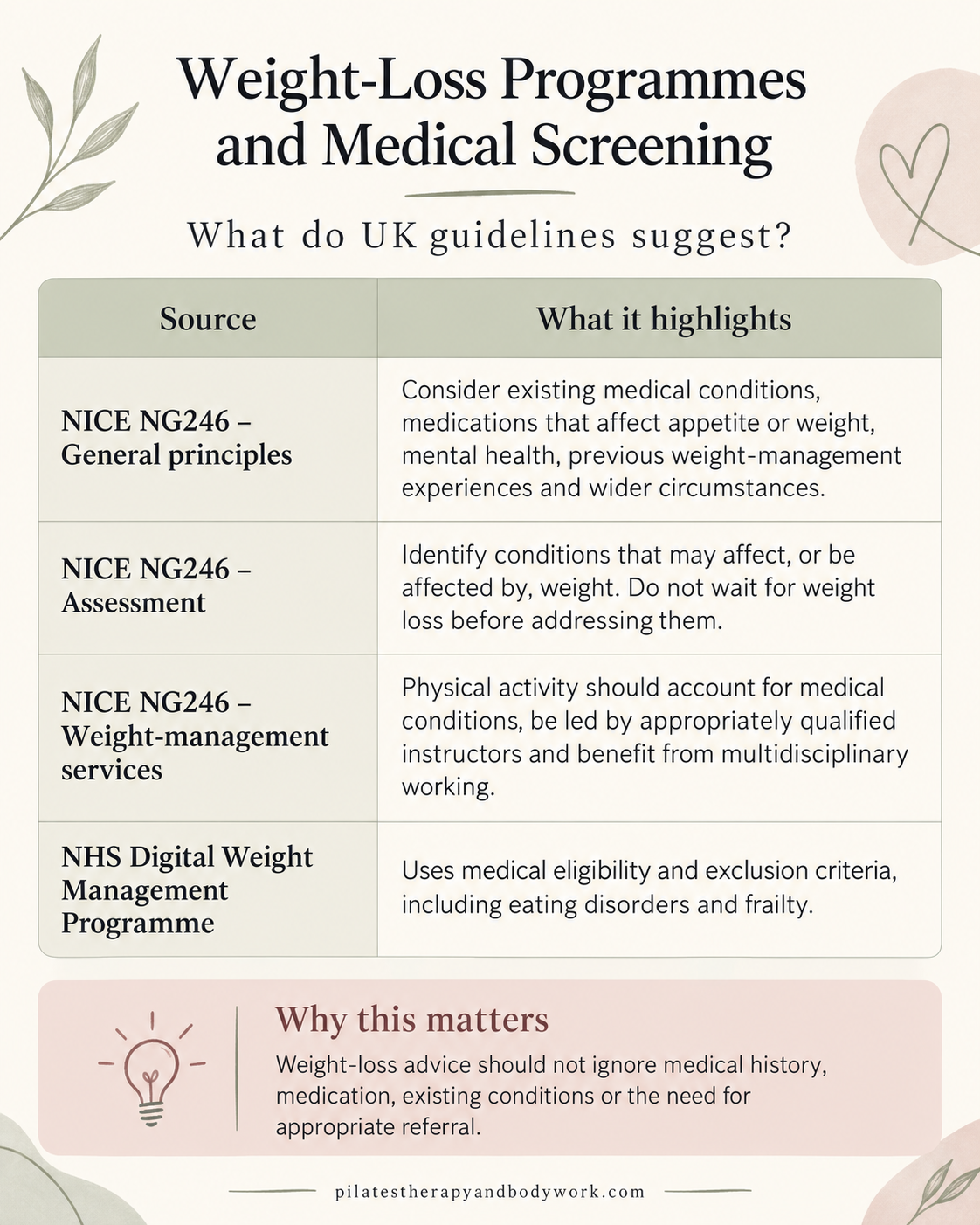
Interestingly, NICE’s updated weight-management guideline (NG246, 2025) makes some very relevant recommendations.
It asks us to consider existing medical conditions, medication, mental health, previous experiences of weight management and the individual’s wider circumstances.
It also recommends that physical activity within weight-management services accounts for medical conditions, is led by appropriately qualified instructors and benefits from multidisciplinary expertise.
Even the NHS Digital Weight Management Programme has medical eligibility and exclusion criteria.
So here’s my question.
If we recognise the importance of screening and professional boundaries when prescribing exercise, shouldn’t we be asking equally important questions before recommending weight-loss programmes, nutrition changes and other wellness interventions?
Not everyone needs specialist intervention. Not every existing condition prevents someone from losing weight.
But surely understanding the person before recommending the programme is a sensible place to begin?
And perhaps the more we learn, the more we realise how much there is still to ask.
-
NICE NG246 – General principles of care — medical history, medication, mental health and wider circumstances.
-
NICE NG246 – Planning and delivering interventions — particularly recommendation 1.19.5.
-
NHS England – Weight Management Programme eligibility — screening and exclusions.
-
CIMSPA – Population specialism standards — working with long-term conditions.