
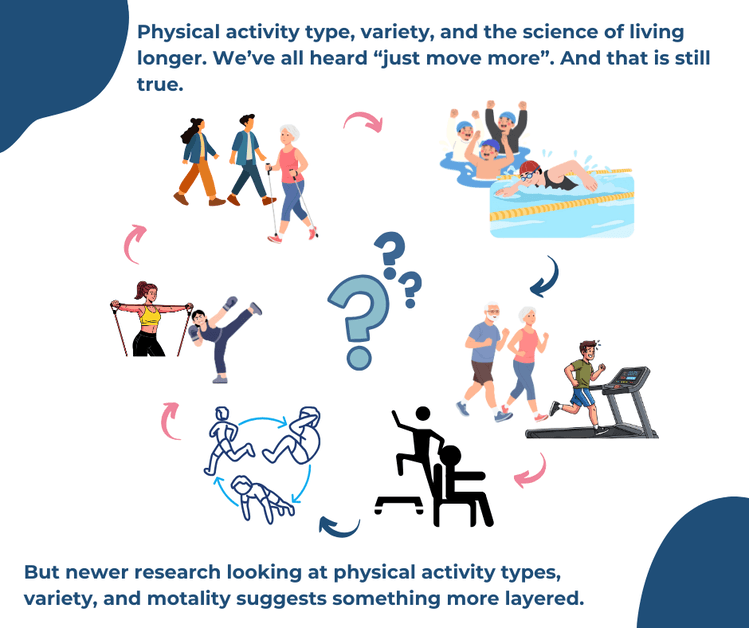

Physical activity type, variety, and the quiet science of living longer
We’ve all heard:
“Just move more.”
And that is still true.
But newer research looking at physical activity types, variety, and mortality suggests something more layered:
The type of movement you choose — and whether you mix it up — may influence long-term health in different ways.
This isn’t about fear.
It’s about understanding your options.
A consistent theme emerges:
Muscle-strengthening activity appears protective.
Especially when combined with cardiovascular challenge.
Based on large cohort data including:
-
Zhao et al., British Journal of Sports Medicine, 2022
-
Saint-Maurice et al., JAMA Network Open, 2020
-
Ekelund et al., The Lancet, 2019
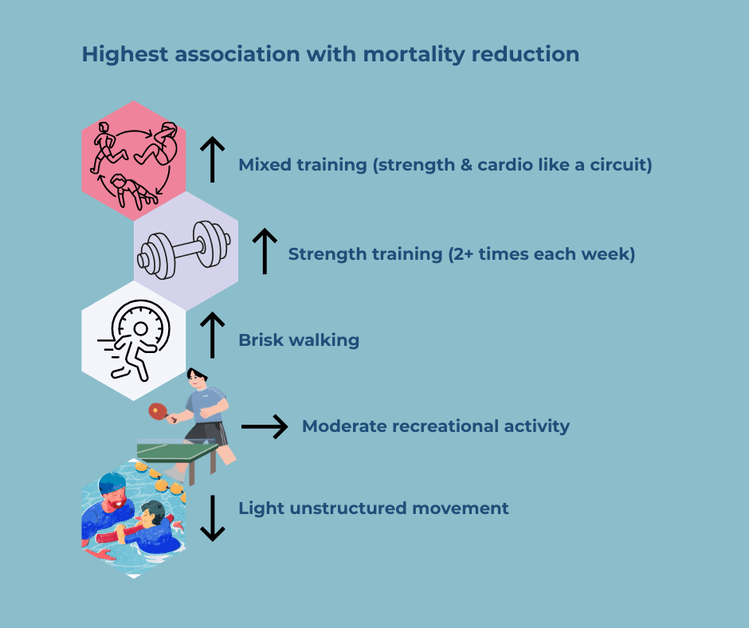
Strength – The Quiet Longevity Tool
Strength training influences:
-
Muscle mass
-
Bone density
-
Insulin sensitivity
-
Metabolic health
-
Functional independence
-
Fall risk
In older adults particularly, muscle mass correlates strongly with survival and quality of life.
This is not about bodybuilding.
It’s about maintaining tissue that protects you.
Swimming – Strong But Context Matters
Swimming is frequently recommended, and for good reason.
It is excellent for:
-
Joint pain
-
Early rehabilitation
-
Cardiovascular conditioning
-
Confidence building
-
Hydrostatic lymphatic support
However, some population studies show weaker associations with mortality reduction compared to structured strength or mixed training.
Possible reasons (not criticism — just physiology):
-
Often steady-state rather than progressive
-
Low skeletal loading (less bone stimulus)
-
Intensity frequently self-selected and moderate
-
Limited resistance stimulus unless programmed deliberately
So the takeaway isn’t:
“Don’t swim.”
It’s:
• If swimming is your main activity, consider adding structure:
-
Intervals
-
Resistance tools
-
Complementary strength work
Cycling – Similar Story, Slightly Different Angle
Cycling often performs better than swimming in mortality studies, particularly when done at moderate-to-vigorous intensity.
It provides:
-
Strong cardiovascular stimulus
-
Lower joint load
-
Good metabolic conditioning
But like swimming, it has limitations:
-
Minimal upper body load
-
Limited bone loading (especially road cycling)
-
Can become steady-state if not varied
Again — brilliant activity.
But if cycling is your only movement, adding resistance training improves overall physiological coverage.
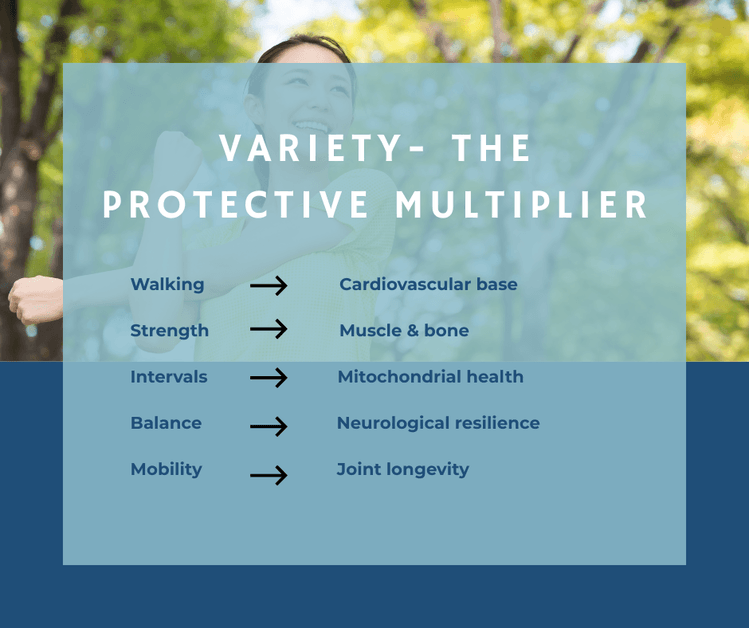
Variety – The Protective Multiplier
Research suggests people engaging in multiple types of activity show stronger health outcomes than those doing just one.
Because different systems respond to different demands:
Walking → cardiovascular base
Strength → muscle & bone
Intervals → mitochondrial health
Balance → neurological resilience
Mobility → joint longevity
Variety reduces vulnerability.
Monotony limits adaptation.
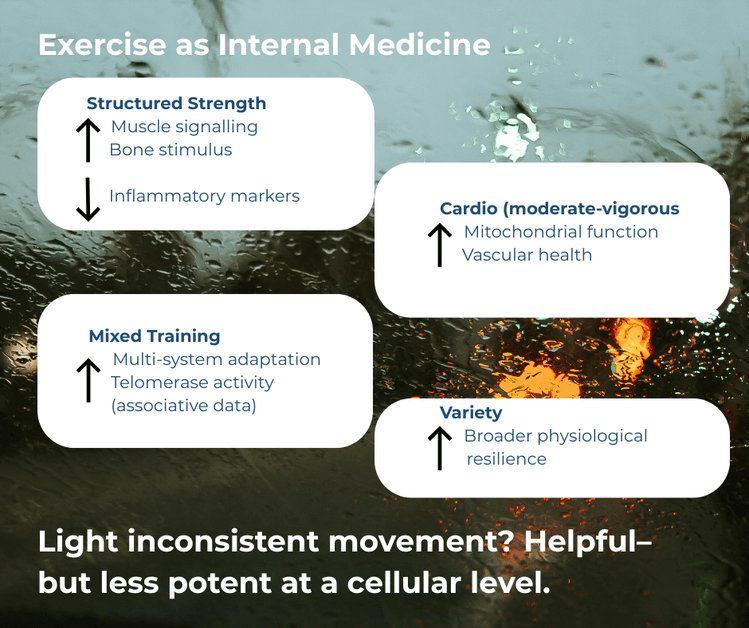
Telomeres, Ageing & “Internal Medicine”
Now let’s zoom right in (because we all know I love a deeper dive).
At the end of our chromosomes are protective caps called:
Telomere
Telomerase
Each time a cell divides, telomeres shorten slightly.
When they shorten too much:
-
Cells lose regenerative capacity
-
Inflammation rises
-
Disease risk increases
-
Biological ageing accelerates
Shorter telomeres are associated with:
-
Cardiovascular disease
-
Some cancers
-
Immune dysfunction
-
Increased mortality
Here’s the hopeful part.
Research (Ludlow 2008; Denham 2013; Puterman 2010) suggests:
-
Regular moderate-to-vigorous exercise
-
Particularly endurance + resistance combined
-
Is associated with longer telomeres
-
Increased telomerase activity
-
Reduced systemic inflammation
In simple terms:
When you challenge your body appropriately,
you stimulate repair pathways.
You improve mitochondrial function.
You reduce chronic low-grade inflammation.
You enhance immune resilience.
You are, in effect:
Creating your own internal anti-ageing, anti-inflammatory medicine.
Not in a miracle way.
But in a measurable, cellular way.
Rehab WALX – The Bridge Activity
Total body walking (Nordic / Rehab WALX) deserves mention.
It:
-
Engages upper body
-
Raises heart rate more than standard walking
-
Improves posture
-
Activates muscle pump (helpful for lymphatic return)
-
Challenges coordination
Research (Tschentscher et al., 2013) shows:
-
Greater oxygen consumption than normal walking
-
Higher caloric expenditure
-
Increased upper body muscle activation
It sits beautifully between:
Gentle walking and structured circuit training.
For cancer recovery and chronic condition management, this can be a powerful, accessible step forward.
Is There Anything Else We Should Mention?
• Sedentary Time
Even active individuals with prolonged sitting periods show increased risk markers.
Breaking up sitting improves metabolic health independently.
• Social Activity
Group-based activity is associated with better adherence and improved long-term health behaviours.
Community may be protective in ways we don’t fully quantify.
My Imperfect Take
This isn’t about telling swimmers or cyclists they’re doing it wrong.
It’s about understanding physiology.
If you can:
-
Walk
-
Strength train
-
Occasionally raise your heart rate
-
Add variety
You are layering protection.
At tissue level.
At mitochondrial level.
At inflammatory level.
At telomere level.
Please get in touch if you would like to join a class