
I have been looking at some of the client progress review photographs from Highwoods Nutrition.
Everyone else was doing exactly what you would expect.
They were celebrating the weight loss.
The smiles.
The healthier faces.
The smaller clothes.
The confidence that seemed to shine a little brighter in every photograph.
And I found myself looking at something completely different.
I was looking at shoulders.
At ribcages.
At pelvises.
At heads.
At the way people were standing.
It suddenly dawned on me that some people looked taller. Some looked as though they had “opened up” through the front of their body. Some no longer leaned backwards quite so much. Others seemed to carry themselves differently in a way I couldn’t quite put into words.
Then I noticed something else.
Even after losing a significant amount of weight, many of the little asymmetries I’d expect to see as a bodyworker were still there.
One shoulder still sat slightly higher.
The ribcage might still drift a little to one side.
The pelvis might still be carrying a familiar tilt.
That observation fascinated me.
Everyone else was seeing weight loss.
I was seeing adaptation.
I’ve spent nearly thirty years watching bodies move.
Not perfect bodies.
Real bodies.
Bodies recovering from cancer treatment.
Bodies living with pain.
Bodies carrying stress.
Bodies getting older.
Bodies that have quietly adapted to whatever life has asked of them.
The longer I’ve worked, the less interested I’ve become in chasing perfect posture.
Instead, I’ve become fascinated by why people stand the way they do.
Why does one shoulder rise?
Why does another person always seem to lean backwards?
Why does someone continue to stand in the same way even after the thing that caused it has gone?
Those questions have probably shaped my career more than any qualification ever has.
Books such as Born to Walk, Born to Move, and later Anatomy Trains by Thomas Myers, along with the work of James Earls, encouraged me to think less about isolated muscles and more about the body as a wonderfully adaptable whole.
Not because they gave me all the answers.
Quite the opposite.
They made me ask better questions.
Our Bodies Are Brilliant at Staying Upright
One of the most remarkable things about the human body is that it will do almost anything to stop us falling over.
Our brain isn’t constantly asking,
“How can I make Fiona symmetrical today?”
It’s asking something much simpler.
“Can we stay upright?”
“Can we keep the eyes level?”
“Can we move safely enough to get through today?”
That changes everything.
Because the body doesn’t necessarily choose the most beautiful solution.
It chooses the one that works.
Sometimes that’s elegant.
Sometimes it’s wonderfully inventive.
Sometimes it looks a little wonky.
But if it keeps us walking, breathing, gardening, carrying grandchildren, climbing stairs or simply getting through another busy week, our nervous system often decides it’s good enough.
I actually find that incredibly reassuring.
Our bodies aren’t failing us.
They’re constantly trying to help us.
“Your body isn’t trying to be perfect. It’s trying to keep you moving.”
Weight Changes Where the Load Acts
Imagine carrying a heavy rucksack all day.
You’d naturally lean forwards or backwards a little.
You might widen your stance.
Your shoulders would organise themselves differently.
Your centre of gravity would change.
Now imagine taking that rucksack off.
The load has disappeared instantly.
Does your posture immediately become perfectly balanced?
Probably not.
Your body has spent months—or perhaps years—learning how to carry that load.
It has become familiar.
Weight works in a similar way.
As our body shape changes, the position of our centre of mass changes too. The forces travelling through our feet, knees, hips and spine also change.
Research has shown that obesity is associated with changes in spinal alignment, particularly in the sagittal (side-view) plane. Studies, including the Yakumo Study from Japan, have demonstrated that increasing body weight is often linked with greater forward trunk inclination, changes in lumbar curvature and altered overall balance. More recent research published in 2023 has continued to show that obesity influences both posture and movement strategies rather than simply increasing the load on joints.
That fits beautifully with what I was noticing in those photographs.
The body wasn’t simply becoming smaller.
It was reorganising itself.
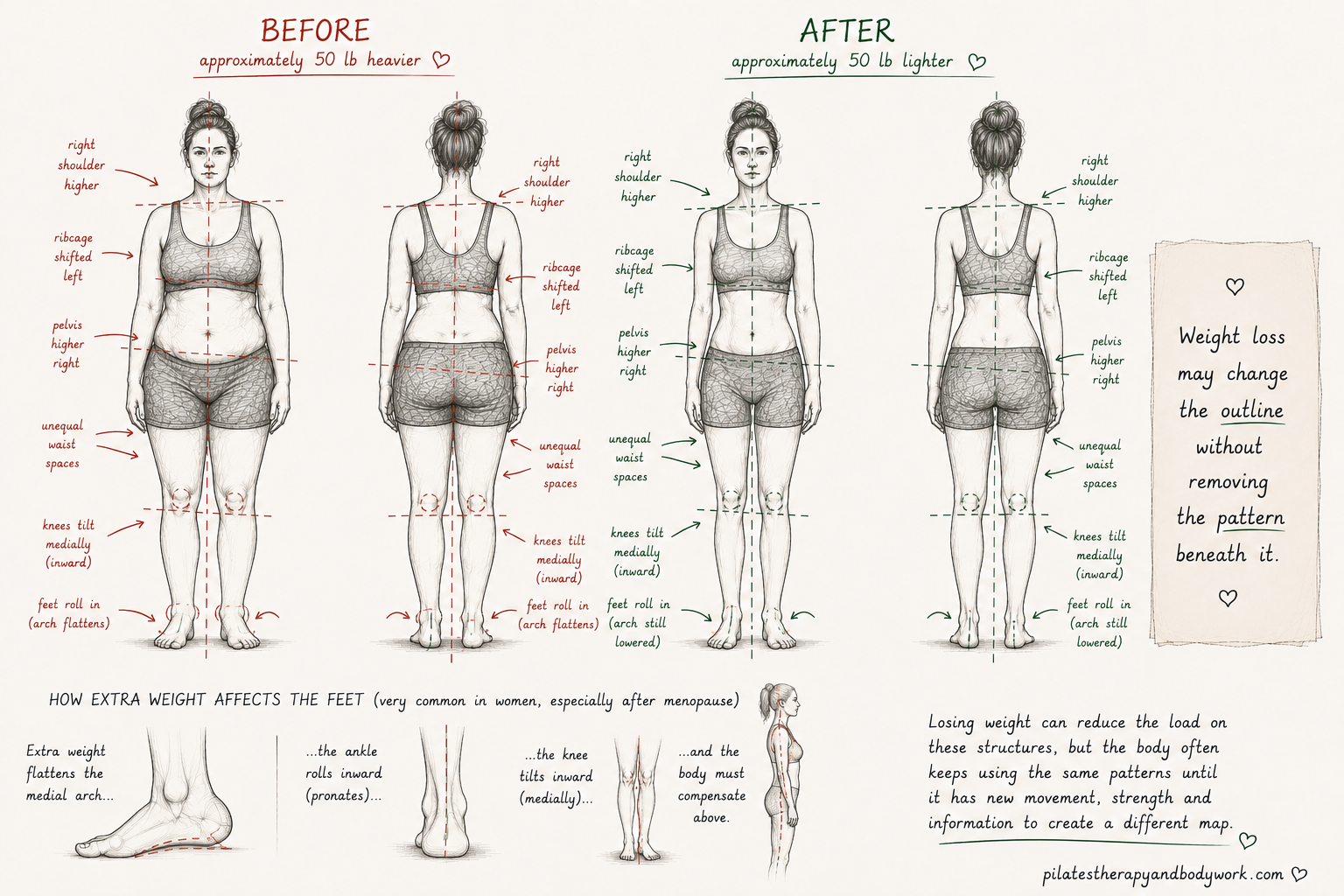
Fi Clinical Pearl
Weight doesn’t just increase load.
It changes where the load acts.
Sometimes that small shift changes everything.
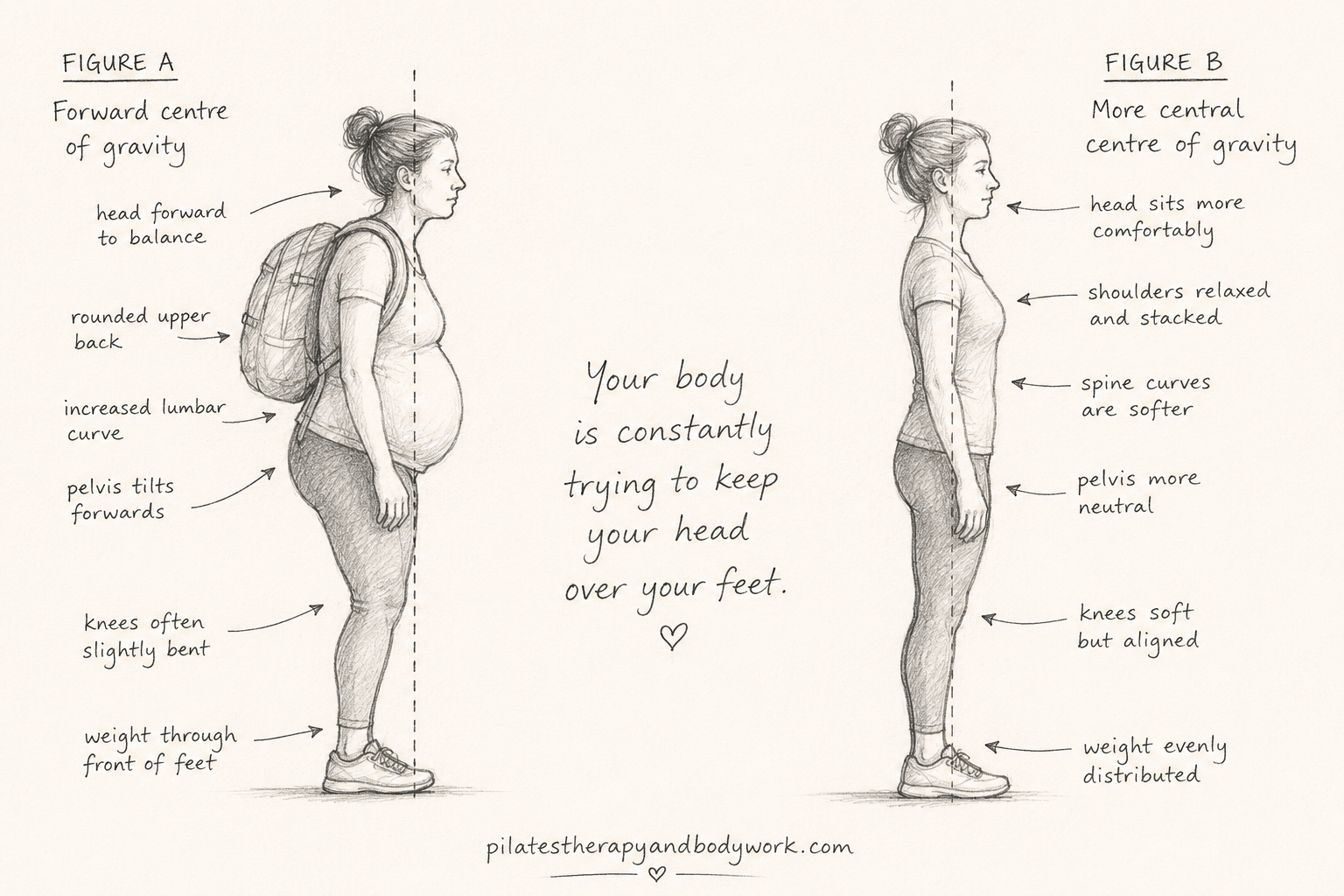
Looking From the Side
The side view was where I noticed the biggest changes.
Many people carrying extra weight gradually develop subtle strategies to keep themselves balanced.
Perhaps the abdomen moves forwards.
The ribcage shifts slightly behind.
The pelvis adjusts.
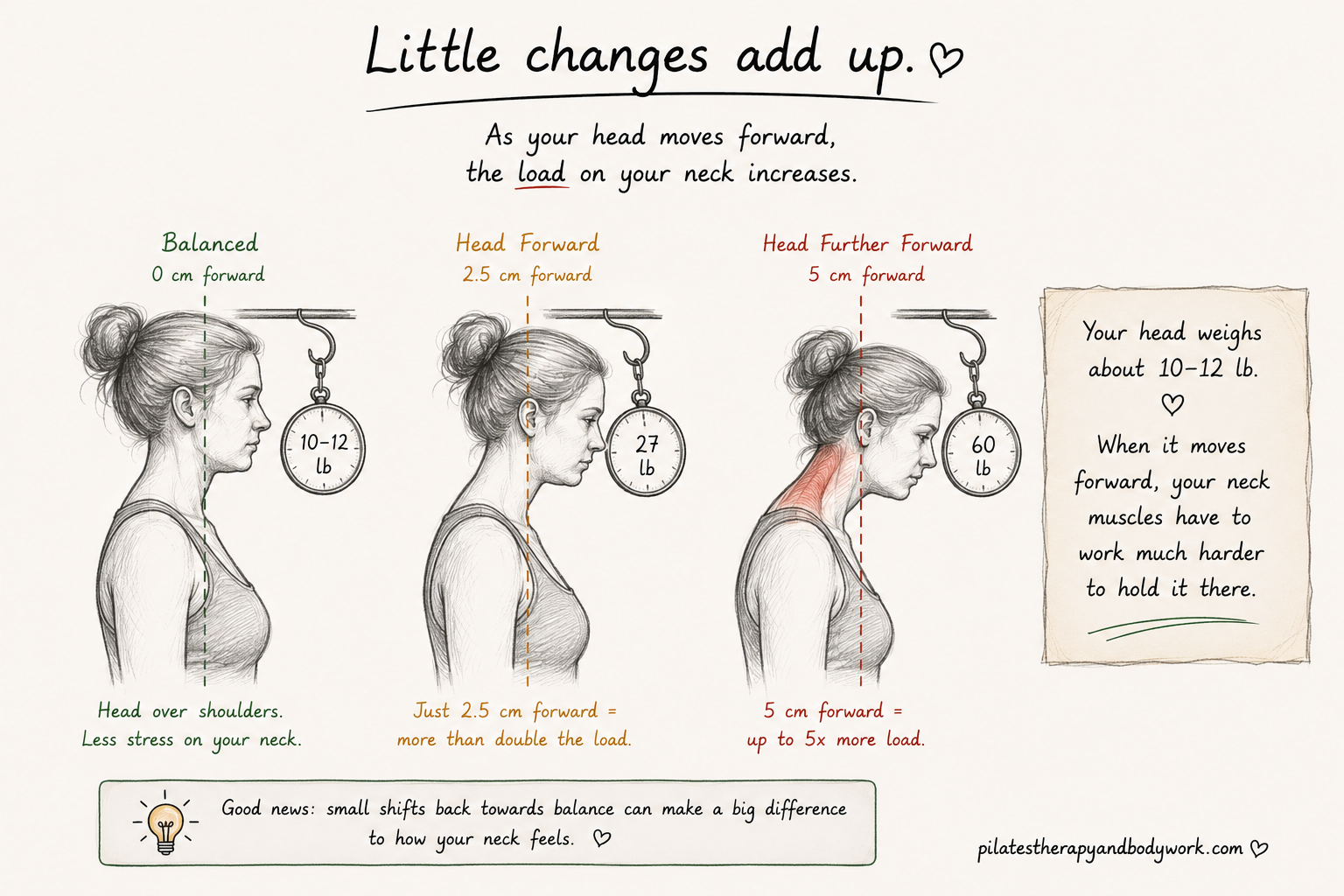
The head gently travels forwards so the eyes continue looking straight ahead.
None of this is “wrong.”
It’s clever.
It’s the body solving a balancing problem.
As weight reduces, those balancing strategies often begin to soften.
People frequently appear taller.
The chest seems more open.
Breathing can look easier.
Walking often becomes smoother.
The body is working with a different set of mechanics.
Some research following people after bariatric surgery has even shown improvements in spinopelvic alignment as body weight reduces, suggesting that the spine and pelvis can begin to reorganise when the mechanical demands placed upon them change.
I find that incredibly hopeful.
Our bodies remain adaptable throughout life.
But…
…and this is the bit I think many people don’t expect…
Not everything changes.
Because posture isn’t just today’s body.
It’s yesterday’s experiences too.
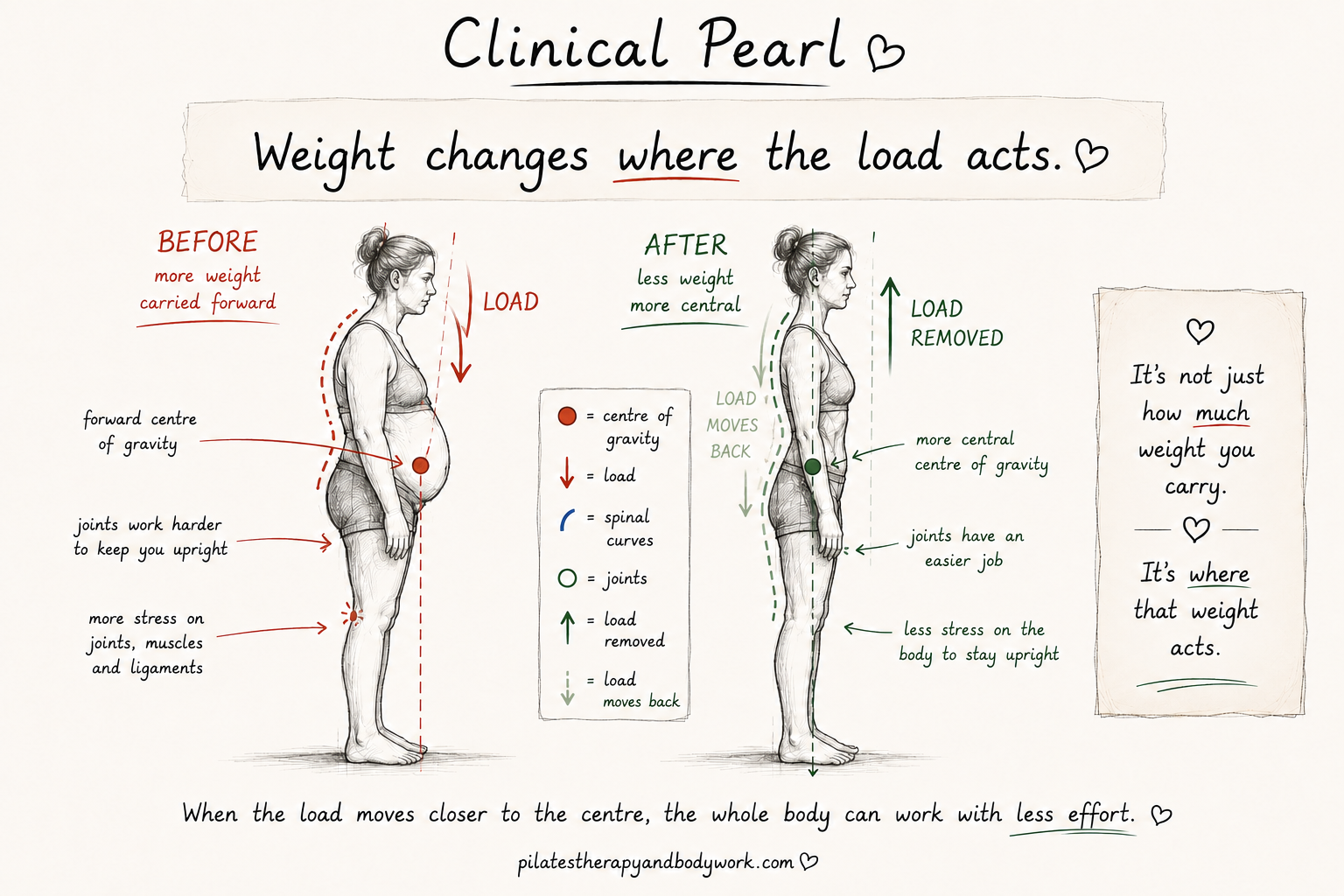
Then I Looked From Behind
This was the really interesting bit.
Even when someone had achieved a remarkable weight loss, I could often still see little clues about how their body had organised itself over the years.
Perhaps one shoulder remained slightly higher.
The ribcage still sat just a little left of the pelvis.
There might still be a small pelvic shift.
Maybe one foot turned out a touch more than the other.
Not dramatic.
Not something most people would notice.
But enough to make me smile.
Because it reminded me that our bodies have memories.
Not memories in the emotional sense.
Mechanical memories.
Patterns that have become familiar because they’ve been repeated thousands upon thousands of times.
And familiar patterns don’t disappear overnight.
They slowly evolve.
Sometimes completely on their own.
Sometimes with a little help.
Fi Field Note
One of the loveliest parts of my job is watching someone realise they don’t need “fixing.”
Their body has simply become very good at solving yesterday’s problem.
Today we’re helping it discover a new solution.
Adaptation or Compensation?
This is one of those conversations I love having in clinic because there isn’t always a neat line between the two.
You’ll often hear practitioners talk about compensation, and sometimes that’s exactly what we’re looking at.
But I also think the word adaptation deserves far more credit.
Adaptation feels kinder.
It acknowledges that the body has responded intelligently to the circumstances it found itself in.
It doesn’t imply something has gone wrong.
It simply recognises that bodies change.
Think about someone who has carried extra weight for ten or twenty years.
Their muscles, fascia, ligaments, joints and nervous system haven’t been waiting patiently for the weight to disappear.
They’ve been busy.
Continuously adjusting.
Continuously finding the most efficient way to keep that person upright and moving.
Every step.
Every day.
When we lose weight, the body doesn’t suddenly receive a memo saying,
“Right everyone… back to factory settings.”
It doesn’t work like that.
It takes time.
The nervous system has to build confidence in a new way of standing.
The connective tissues begin adapting to different loads.
Muscles that have worked incredibly hard for years may finally get a chance to relax a little, while others quietly wake up and begin contributing more.
It’s less like flicking a switch and more like learning a new dance.
“Bodies don’t forget overnight. They gradually discover a new normal.”
Why Forward Head Posture Sometimes Improves… and Sometimes Doesn’t
One of the things I often noticed in those photographs was the position of the head.
Sometimes, after weight loss, the head naturally appeared to sit a little further back over the body.
Sometimes it barely changed at all.
Again, that made perfect sense to me.
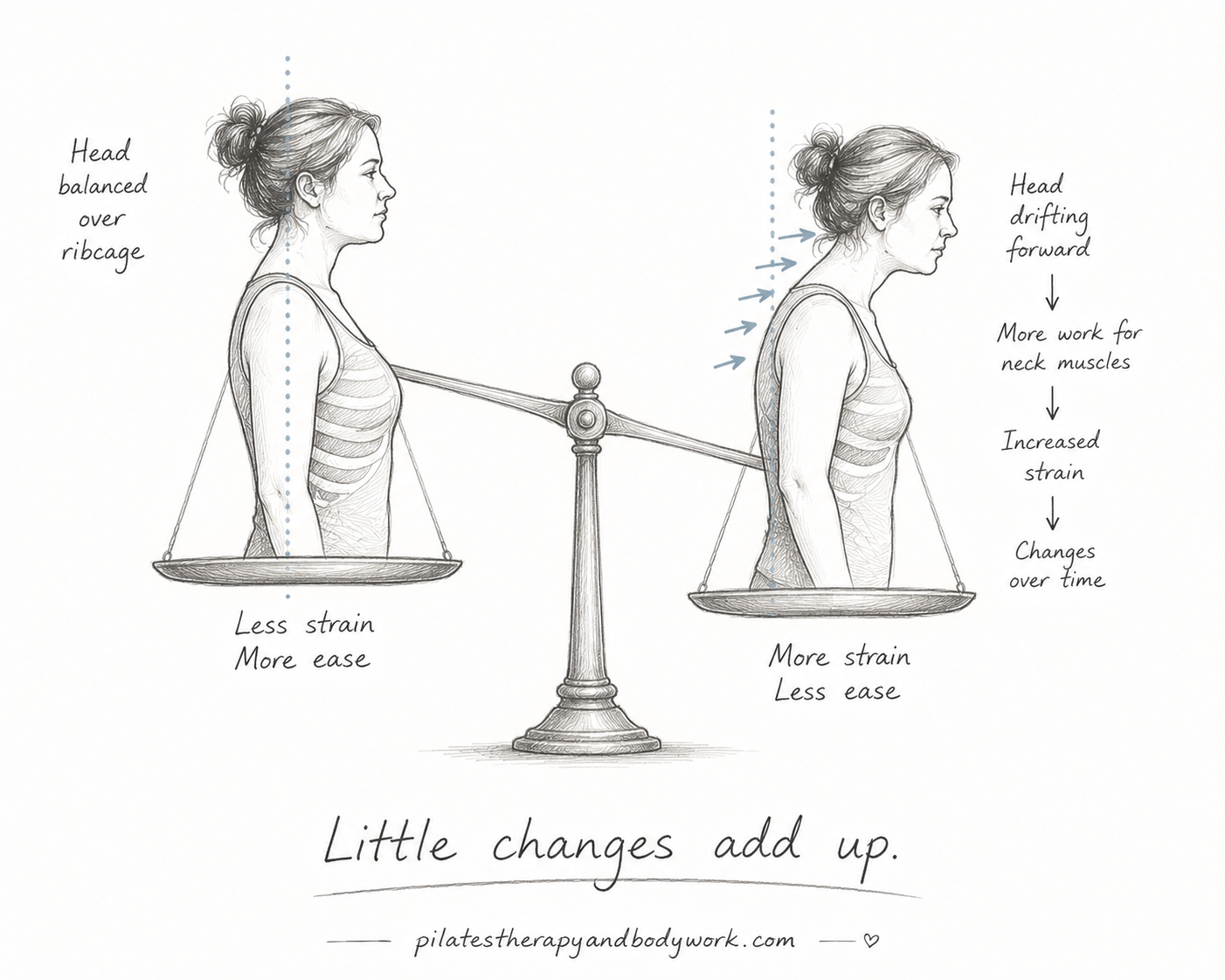
If the body has gradually adjusted to changes lower down, the head often follows suit. After all, one of our biggest priorities is keeping the eyes level with the horizon. The head is remarkably good at finding a position that allows us to see where we’re going.
Research over the past decade has linked greater forward head posture with increased neck pain and certain types of headache. The relationship isn’t always straightforward—plenty of people with a forward head posture have no pain at all—but studies suggest that when the head travels further forwards, the muscles around the neck and shoulders often have to work harder to support it.
That doesn’t mean we should panic every time we notice our head creeping forwards.
Far from it.
Bodies are wonderfully individual.
Some people have a very obvious forward head posture and no symptoms whatsoever.
Others develop neck tension with only a subtle change.
That’s why I always come back to the person standing in front of me rather than trying to make everyone fit a textbook picture.
You may find posture after cancer treatment interesting and also Modern posture and breathing
Fi Clinical Pearl
A posture isn’t a diagnosis.
It’s simply one piece of information.
What About Low Back Pain?
This is probably one of the questions I’m asked most often.
“If I lose weight, will my back pain disappear?”
Sometimes it does.
Sometimes it improves.
Sometimes it changes.
Sometimes… it doesn’t.
That answer probably isn’t as satisfying as you’d hoped, but it’s the honest one.
We know from research that weight loss is often associated with reductions in low back pain and improvements in function. Less load through the spine and lower limbs can make everyday movement easier, and many people report feeling freer and more comfortable.
Studies following people after bariatric surgery have also shown improvements in spinal alignment alongside reductions in pain for many individuals.
But pain is rarely caused by one thing alone.
It’s influenced by movement habits, previous injuries, strength, sleep, stress, confidence, connective tissue, general health and the nervous system, to name just a few.
So while reducing load is undoubtedly helpful, it’s rarely the whole story.
That’s another reason those Highwoods photographs fascinated me.
Some of the structural changes were clearly improving.
Others had simply become part of that person’s movement vocabulary over many years.
Fi Field Note
Whenever someone tells me they’ve lost a significant amount of weight, I’m curious long before I start treating them.
Not because I’m looking for problems.
Because I’m wondering what their body has quietly been reorganising.
And Then There Are the Feet…
The feet don’t always get the credit they deserve.
Yet they’re our entire foundation. Read more about the feet here
Every step we take begins there.
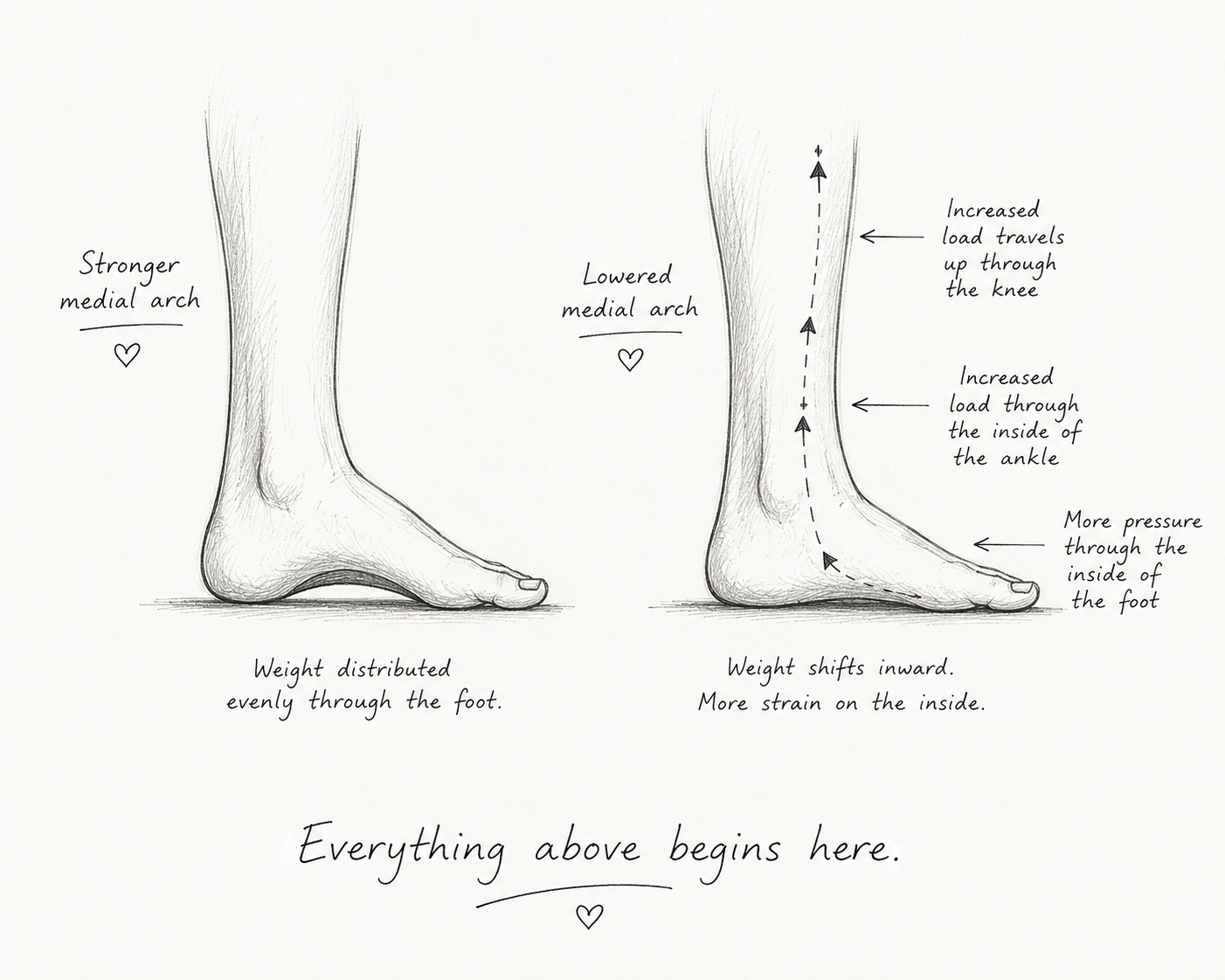
Over the years, carrying additional body weight places greater demand on the feet. Research has consistently shown that increased body weight is associated with a tendency towards flattening of the medial arch, greater pronation and altered loading through the foot and ankle.
It’s something I see regularly.
The arch gently lowers.
The ankle rolls in a little more.
The knee often follows.
The pelvis responds.
The rest of the body quietly joins the conversation.
Then something interesting happens.
Someone loses weight.
Their feet often become happier because there’s simply less load travelling through them.
But…
That doesn’t necessarily mean the arch instantly springs back to where it was twenty years earlier.
Like every other part of the body, the feet have adapted.
Connective tissues have remodelled.
Muscles have learnt different jobs.
The nervous system has developed familiar movement patterns.
Everything takes time.
For many women, particularly after menopause, there can be another layer to consider. Changes in collagen and connective tissue mean that the tissues naturally become a little less elastic than they once were. Combined with years of accumulated loading, it’s another gentle reminder that our bodies are continually changing throughout life.
Again…
Not failing.
Changing
“Your feet have been carrying you through every chapter of your life. They deserve a little kindness too.”
The Body Doesn’t Read the Scales
One thought kept returning to me while I was looking through those photographs.
Our bodies don’t know we’ve reached a target weight.
They don’t celebrate losing three stone.
They don’t care what size jeans we now wear.
They simply respond to the information they receive every single day.
Different loads.
Different movement.
Different breathing.
Different confidence.
Different habits.
Little by little, they begin adapting again.
I actually find that quite beautiful.
Because it means change doesn’t stop when the weight loss does.
Our bodies remain wonderfully capable of learning.
Of reorganising.
Of becoming more efficient.
Of finding easier ways to move.
And sometimes, all they need is the opportunity.
So Where Does Bodywork Fit Into All This?
This is usually the point where people expect me to say,
“This is why everyone needs bodywork.”
Actually…
That’s not what I believe.
Our bodies are incredibly capable of adapting on their own.
They do it every single day.
Lose weight.
Gain strength.
Start walking.
Take up gardening again.
Begin sleeping better.
Reduce stress.
Become more active.
All of those things give the body new information to work with, and many people naturally begin moving more freely without ever stepping into a treatment room.
I think that’s wonderful.
But sometimes the body has become so familiar with an old strategy that it benefits from a little conversation.
Not a battle.
Not someone forcing it into a perfect posture.
A conversation.
That’s how I’ve gradually come to see bodywork over the years.
Whether I’m using Structural Integration, scar therapy, massage, reflexology or movement, my job isn’t to “put people back into alignment.”
It’s to help the body notice that another option might now be available.
Sometimes that means helping tissues move a little more freely.
Sometimes it’s improving awareness.
Sometimes it’s simply giving the nervous system permission to let go of a strategy it no longer needs.
If someone has invested months—or even years—improving their health through weight loss, I actually think it’s worth considering that the next investment might be helping their body integrate those changes.
Not because anything is broken.
Because change deserves support.
Fi Clinical Pearl
If you’ve changed your body significantly, don’t forget you’ve also changed the forces travelling through it.
Sometimes your body simply appreciates a little time—and occasionally a little help—to catch up.
Looking Beyond the Mirror
One of the things I love most about the human body is that it’s never just one system.
Weight affects breathing.
Breathing affects the ribcage.
The ribcage influences the spine.
The spine influences the pelvis.
The pelvis changes the legs.
The legs influence the feet.
The feet send information all the way back to the brain.
Everything talks to everything else.
That’s one of the reasons I’ve never been able to think about posture as simply “standing up straight.”
It’s a conversation.
A continuous exchange between our brain, our connective tissue, our muscles, our joints and the environment around us.
That’s also why two people can lose exactly the same amount of weight and finish with completely different postures.
Different histories.
Different injuries.
Different pregnancies.
Different occupations.
Different hobbies.
Different stress.
Different movement.
Different stories.
And every single one of those stories has left a gentle fingerprint on the body.
“Bodies don’t all arrive at the same destination. They simply become the best version of themselves with the information they’ve been given.”
Standing on the Shoulders of Giants
One of the greatest gifts of working in healthcare is realising that none of us think in isolation.
Every patient I’ve ever met has taught me something.
Every colleague has influenced the way I look at movement.
Every book has nudged another little door open.
When I began looking at bodies through a more global lens, authors such as Thomas Myers with Anatomy Trains, and James Earls Born to Walk all encouraged me to think beyond individual muscles and ask how the whole body shares load.
Those ideas didn’t replace clinical reasoning.
They enriched it.
Research into obesity, spinal alignment, biomechanics, fascia and movement continues to evolve every year.
I’m grateful for every scientist who quietly measures what many clinicians first notice with their eyes and hands.
Together, they remind us that curiosity matters.
Questions matter.
Observation matters.
And perhaps that’s exactly where this blog began.
Not with an answer.
With a question.
Conclusion
I went to Highwoods Nutrition expecting to admire remarkable weight loss.
I left thinking about posture.
That’s probably the most “Fi” thing I’ve ever written.
As everyone celebrated the incredible achievement of becoming healthier, my brain quietly wandered off wondering why one shoulder was still slightly higher.
Why someone’s head still sat a little forwards.
Why one foot still turned out.
Not because I thought those things were problems.
Because I found them fascinating.
They reminded me that our bodies aren’t machines with replacement parts.
They’re living, learning systems.
Every day they adapt to the loads we place upon them.
Every day they try to keep us balanced.
Every day they quietly rewrite our movement story.
Losing weight changes that story.
Sometimes dramatically.
Sometimes subtly.
But it doesn’t erase every chapter that came before.
And perhaps that’s exactly as it should be.
Our posture is part of our history.
Not something to judge.
Something to understand.
So if you’ve recently lost weight and caught sight of yourself in the mirror thinking,
“I look different… but not quite how I expected,”
I’d encourage you to look again.
Not with criticism.
With curiosity.
Because your body has been working incredibly hard for you.
And if you look closely enough…
You might just see the story it’s been telling all along.
Fi Field Note
One of the greatest privileges of my work is watching people stop apologising for their bodies.
The moment curiosity replaces criticism is often the moment real change begins.
Further Reading
If this topic has sparked your curiosity, these papers and books provide an excellent starting point:
- Iizuka Y. et al. Association Between Obesity and Sagittal Spinal Alignment (Yakumo Study).
- Systematic reviews examining weight loss and low back pain.
- Research investigating spinopelvic alignment after bariatric surgery.
- Reviews on forward head posture, neck pain and cervicogenic headache.
- Studies exploring body weight, medial arch height and foot biomechanics.
- Research into connective tissue changes associated with menopause.
- Thomas Myers — Anatomy Trains.
- James Earls — Born to Walk.
- Born to Move.