
When Life Gives You Lemons… Put Some Headphones On
Or: how one set of silent disco headsets accidentally became one of the most versatile bits of kit I own.
Sometimes an idea starts with a carefully researched business plan.
And sometimes you have a box of silent disco headsets and think:
What else can I do with these?
Mine were originally bought for something fairly obvious — silent disco-style movement. Music in your ears, freedom to move, and considerably less chance of annoying everyone within a half-mile radius.
But they have gradually found their way into several completely different parts of my work.
Cancer support groups.
Pop-up silent discos.
Fi’s Fit Mix.
And now, rather unexpectedly, immersive relaxation.
The same box of headphones.
Which sent me down another rabbit hole.
Is there actually something interesting happening here beyond the novelty?
As it turns out, there might be.

🎧 First stop: movement without taking over the room
One of my favourite uses has been within cancer support groups.
These groups aren’t exercise classes. People come to meet, talk, have a cuppa, share experiences and simply be around other people who understand.
But movement matters too.
So how do you introduce a little movement without suddenly turning the entire meeting into Fi’s Exercise Hour?
Headphones gave me an answer.
Those who want to join me can put them on. I can talk directly into their ears, play music and guide a gentle movement session — while conversations elsewhere in the room can continue.
It creates a little movement bubble inside a much bigger social space.
And I rather like that.
Nobody has to participate. Nobody has to stop talking because I’ve turned music on. And movement can sit alongside the social support rather than replacing it.
We now have a dedicated Meet N Move session in Jaywick.
This session is run from Golf Green Hall 3 weeks of the month: we have a movement session that can be adapted to the needs of anyone attending. Headsets used weekly.
On the 3rd Monday of the Month we use the Rehab Poles and have a walk from Rainy Bakes Cafe.
This group took took 6 months to set up and has grown to regularly have 6-8 people attending

🟢 WHAT WE KNOW
There is substantial evidence that music can influence our experience of movement.
A large meta-analysis looking at music across exercise and sport found benefits for enjoyment/positive feelings during activity, physical performance and perceived exertion — essentially, activity can feel a little easier with music.
That doesn’t prove that my cancer-group-headphone idea has a therapeutic effect.
But it gives a perfectly reasonable explanation for something many of us instinctively recognise:
Music can change how movement feels.
And if something feels more enjoyable and approachable, perhaps we’re more inclined to do it.
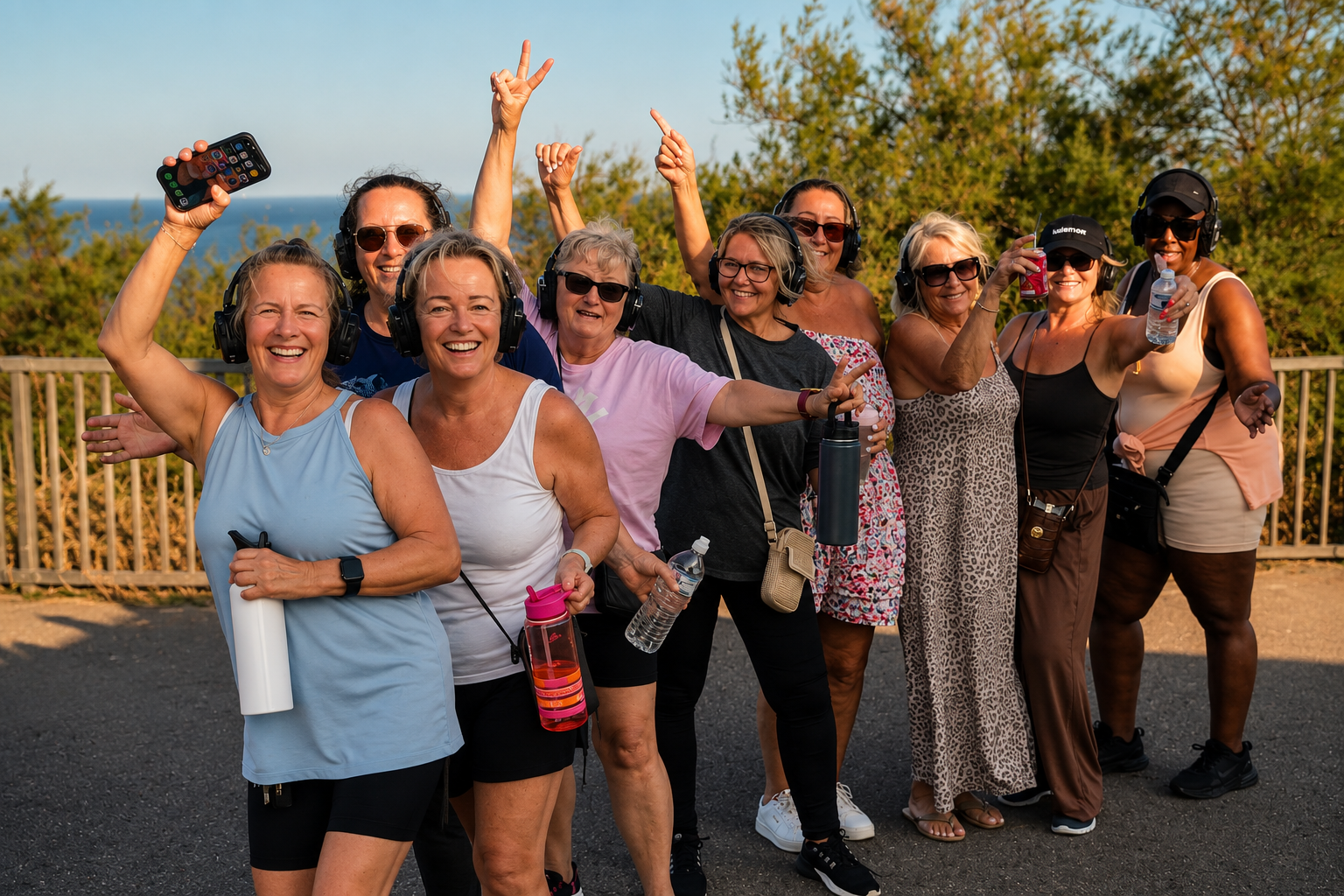
💃 Then came the silent disco
This is where the headphones really earn their name.
Music on.
Headsets on.
Move.
Dance.
Walk.
Laugh.
Nobody needs to perform. You don’t need complicated choreography and, importantly in my world, movement can be adapted.
Silent disco research itself is still relatively young, but I was delighted to discover researchers really are looking at it.
Studies involving older adults have explored silent disco headphones in hospital and long-term-care environments.

One hospital study found the technology feasible and acceptable among older adults and reported positive experiences around mood, engagement and wellbeing.
More recent work in long-term care has explored silent discos as shared social experiences. Researchers have reported themes around social interaction, inclusion, connection and community.
🟠 MIND THE GAP
This does not mean researchers have proved that going to a silent disco makes you healthier.
Much of the silent-disco-specific research is qualitative and has involved particular populations, including older adults in care settings.
But it does suggest something worth exploring.
Headphones can create the slightly peculiar combination of:
a personal experience + a shared experience.
You’re in your own musical world.
But you’re also part of the group.
I think that’s rather lovely.

🚶 And then the headphones went outside…
Enter Fi’s Fit Mix.
Walk it. Step it. Squat it. Strengthen it.
This isn’t a silent disco in the traditional sense. The headsets allow me to combine music with instruction while we’re moving outside.
Everyone can hear me without me shouting across the seafront.
I can coach while we walk.
Music can accompany harder sections.
And because it’s delivered directly through the headset, we’re not imposing our soundtrack on everybody else enjoying the promenade.
Again, the research doesn’t tell us that headphones make Fi’s Fit Mix work.
But the broader music-and-exercise literature gives us some interesting clues.
Music has been associated with more positive feelings during exercise and reduced perceived exertion, alongside small improvements in performance and physiological efficiency.
Perhaps sometimes music isn’t just background noise.
It helps create the experience.
The headsets and Walx rehab poles are used within this session. Meeting at Holland On Sea Outdoor gym.
🧡 Then cancer support brought me back to music again
This was where my rabbit hole became particularly interesting.
Music interventions have been studied quite extensively in people affected by cancer.

A Cochrane review concluded that music interventions may have beneficial effects on anxiety, depression, hope, pain and fatigue in adults with cancer, although much of the evidence was judged to be low certainty and many studies had a high risk of bias.
Other systematic reviews and meta-analyses have reported improvements in areas including anxiety, mood and pain.
And a large overview of systematic reviews — covering more than 9,000 participants — concluded that music-based interventions alongside standard care appeared potentially helpful for cancer-related pain, fatigue and distress, while also pointing out substantial variation and methodological limitations in the research.
That’s important.
Because this isn’t:
“Put headphones on and music treats cancer symptoms.”
It absolutely doesn’t.
It is much more interesting — and useful — than that.
Music may be another supportive tool.
And supportive tools matter.
😴 And now… Permission to Pause
This might be my favourite unexpected evolution of the headphones.
What happens if instead of using them to encourage people to move…
…I use them to help people become still?
I’m developing a workshop called Permission to Pause.
We’ll explore some of the things that may help us switch off: sleep habits, gentle movement and body softening, breathing, mindfulness and simple ways of settling a busy brain.

Then we’ll finish with an immersive guided relaxation delivered through the headsets.
Same equipment.
Completely different purpose.
And once again, music and sound become part of the environment rather than simply something playing in the background.
There is research supporting music-based interventions for relaxation and psychological wellbeing, including within cancer care. But I’m deliberately not calling what I do music therapy — that is a professional discipline in its own right.
I’m simply using music, sound, movement and relaxation within my own scope of practice.
There’s a difference.
🐇 THE FI RABBIT HOLE
The really interesting question for me isn’t:
“Do silent disco headphones work?”
That’s far too simplistic.
The headphones are just the delivery system.
What interests me is what they allow us to change.
They can make music personal without making the activity antisocial.
They can allow one small group to move while another continues talking.
They let me coach outdoors without shouting.
They can turn a familiar space into somewhere that feels temporarily different.
They can support movement.
Or dancing.
Or stillness.
And because I already own them, I can experiment with all of this without buying thousands of pounds’ worth of shiny new wellness equipment.
That’s quite important too.
🍋 When life gives you lemons…
I often talk about using the tools already in my toolbox.
Perhaps equipment deserves the same treatment.
I could have looked at my silent disco headsets and thought:
They’re for silent disco.
Instead, they’ve become part of cancer support, outdoor movement, community events and now relaxation.
And I suspect I haven’t finished finding uses for them yet.
There is something I particularly like about that.

Wellbeing doesn’t always need another expensive machine, another complicated programme or another grand promise.
Sometimes it needs a good idea, a bit of curiosity and something you already have sitting in a cupboard.
If life gives you lemons, make lemonade.
And if life gives you 20 silent disco headsets…
apparently I start another rabbit hole.
🐇 Rabbit-hole reading
Karageorghis & Priest — Music in exercise and sport
A large meta-analysis found that music was associated with more positive feelings during physical activity, improved performance and reduced perceived exertion.
Fi thought: Perhaps the playlist isn’t merely decoration. It may change how movement is experienced.
Cochrane — Music interventions for people with cancer
The review found possible benefits for anxiety, depression, hope, pain and fatigue, while rating much of the evidence as low certainty.
Fi thought: Interesting enough to use thoughtfully; nowhere near strong enough to make miracle claims. Exactly where I like my rabbit holes.
Bro et al. — Music interventions in cancer treatment
Twenty-five randomised controlled trials were included. Music was associated with reductions in anxiety and pain and improvements in mood, but study quality and heterogeneity limit firm conclusions. Interestingly, passive listening to self-selected recorded music appeared particularly promising.
Fi thought: Choice might matter. Perhaps we shouldn’t always assume our relaxing music is somebody else’s relaxing music.
Hung et al. — Silent disco headphones in hospital
A small feasibility study explored headphones with older adults and found encouraging experiences around mood, engagement and wellbeing.
Fi thought: Finally — actual silent disco headphone research! Small and early, but definitely one to watch.
Silent disco in long-term care
More recent research has explored the social side of silent disco, reporting themes around inclusion, interaction, community and shared experience.
Fi thought: Maybe the clever bit isn’t shutting everyone else out. Perhaps headphones can sometimes help people join in.
I use movement, music, touch and relaxation in different ways across my clinic, community work and classes. If one of these ideas has made you curious, have a look at what I’m currently running — from Fi’s Fit Mix and cancer-support sessions to the developing Permission to Pause workshops.