
The Male Pelvic Floor, Prostate Cancer & The Bit We Don’t Talk About Enough
Pelvic-floor training, continence, swelling, lymphatics, fascia — and why “just do your Kegels” may be rather too simple
If I say pelvic floor, what do you picture?
Pregnancy?
Childbirth?
Women doing pelvic-floor exercises while waiting for the kettle to boil?
For decades, pelvic-floor conversations have overwhelmingly centred around women.
But men have one too.
And for somebody going through prostate problems — particularly prostate cancer and its treatment — that relatively small group of muscles can suddenly become very important indeed.
Urinary leakage after prostate surgery is probably the issue most people have heard about.
But the more I looked at the male pelvic floor, the more questions appeared.
What actually happens to continence after the prostate is removed?
When should pelvic-floor training begin?
Does it matter whether somebody is actually contracting the right muscles?
What about breathing and pressure?
What about the abdominal wall?
What about fascia and scar?
And then, inevitably, my lymphatic brain joined the conversation…
What happens to the tissues after intervention?
Could swelling within the pelvis influence how the pelvic floor feels or functions — even when we can’t see obvious oedema from the outside?
And if it can…
could reducing that swelling potentially help?
🐇
You know what happens next.
Down the rabbit hole we go.

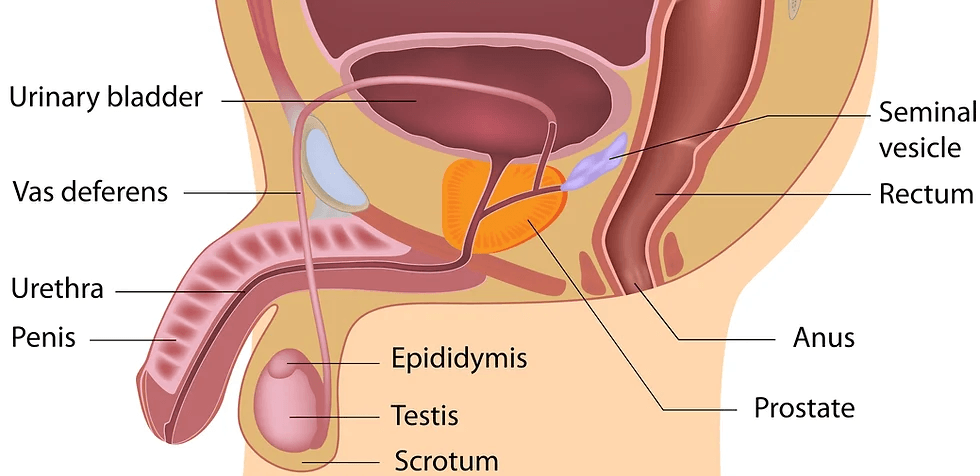
First, where exactly is the prostate?
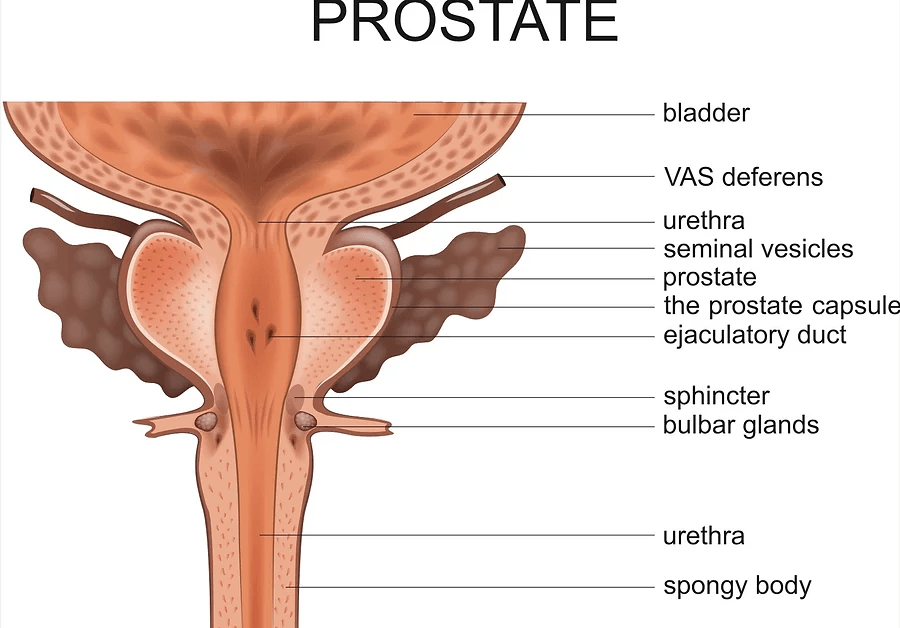
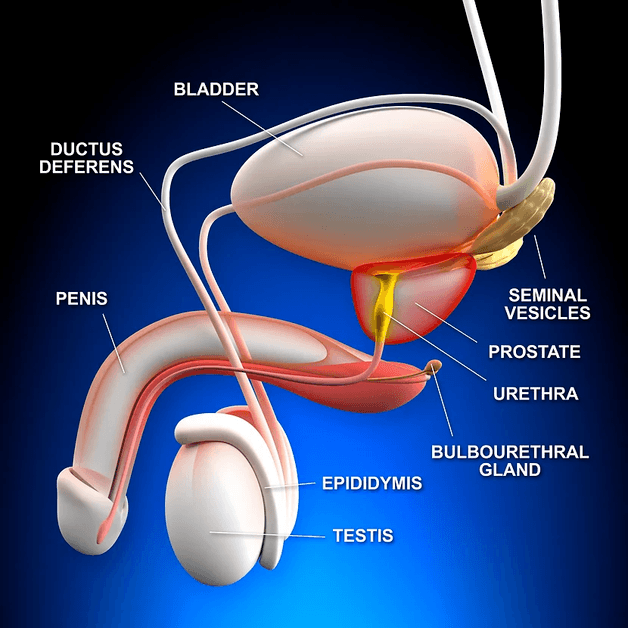
The prostate is a small gland — often described as roughly walnut-sized in a younger adult — sitting below the bladder and in front of the rectum.
The urethra, the tube carrying urine out of the bladder, passes through the prostate.
That relationship becomes very important when we talk about prostate surgery.
Because continence isn’t controlled by one solitary muscle that can simply be switched back on afterwards.
It involves a coordinated system that includes the bladder, urethra, sphincter mechanisms, pelvic-floor muscles, connective tissues and nervous system.
And sitting in the middle of that neighbourhood is the prostate.
So when we intervene there, it shouldn’t be terribly surprising that the surrounding system may need time — and sometimes rehabilitation — afterwards.
Not every prostate problem is cancer
The prostate can cause problems for several reasons.
Benign prostatic enlargement can affect urinary flow as the prostate enlarges around the urethra.
Prostatitis involves inflammation of the prostate and may cause pain and urinary symptoms.
And then there is prostate cancer.
Depending upon the cancer and the individual, prostate cancer management can include active surveillance, surgery, radiotherapy, hormone therapy — androgen-deprivation therapy — and other systemic treatments.
Each brings a different rehabilitation picture.
So already:
“Prostate problem = do pelvic-floor exercises”
is looking rather simplistic.
What happens with prostate surgery?
A radical prostatectomy removes the prostate gland and seminal vesicles, with the bladder then reconnected to the urethra.
That is major pelvic surgery.
One possible consequence is urinary incontinence, particularly in the earlier stages of recovery.
And this is where pelvic-floor muscle training — PFMT — enters the picture.
There is now a substantial body of research investigating PFMT following radical prostatectomy.
A 2025 systematic review looked at 20 randomised controlled trials involving 2,444 men. All the studies included structured, supervised PFMT after confirming that participants could correctly contract their pelvic-floor muscles.
Thirteen of the 20 trials reported significant improvements in continence recovery or symptom severity. The review suggested that early intervention, greater training intensity, targeted training and in some studies biofeedback may be useful — although protocols varied considerably.

And a newly published 2026 systematic review and network meta-analysis has now looked across 30 randomised trials involving 3,246 men. It again supports PFMT-based rehabilitation after radical prostatectomy, but importantly, the evidence did not establish one specific PFMT strategy as clearly superior across the evidence base.
That last bit matters.
Because it brings us beautifully to one of my favourite words:
Individualise.
So should men train their pelvic floor before surgery?
This is where the evidence gets more nuanced.
Pre-operative pelvic-floor training is increasingly used to help somebody identify the correct muscles before surgery.
And logically, that has appeal.
Learning a new skill when you’re comfortable, continent and not recovering from major surgery seems rather easier than trying to learn it afterwards.
But logical isn’t the same as proven.
A 2025 systematic review of pelvic-floor rehabilitation before radical prostatectomy found evidence suggesting pre-operative training may help early continence recovery, but the studies and protocols were heterogeneous.
Research into pre-operative biofeedback specifically has also produced inconclusive findings.
So I wouldn’t say:
“Everyone must do exactly this programme before prostate surgery.”
I would say:
Learning how to identify and appropriately use your pelvic floor before surgery may be useful — and deserves more attention than handing someone a leaflet afterwards.
Because “squeeze” isn’t always as simple as it sounds
Ask somebody to contract their pelvic floor and all sorts of things can happen.
Bottom clenches.
Abdominals brace.
Breath stops.
Shoulders rise.
Everything tightens.
And somewhere underneath all of that, we’re hoping the pelvic floor has joined in.
😆
This is why confirmed contraction is an important detail in some of the stronger PFMT research.
The 2025 systematic review specifically included studies in which correct pelvic-floor activation had been confirmed before the training programme began.
Because repetition isn’t particularly useful if we’re repeatedly practising the wrong strategy.
And pelvic-floor rehabilitation isn’t simply about producing the biggest possible squeeze.
These muscles need to:
contract,
relax,
respond to pressure,
coordinate with breathing and movement,
and function during ordinary life.
Coughing.
Standing.
Walking.
Lifting.
Getting out of a chair.
Laughing.
And occasionally making it to the toilet rather more urgently than planned.
That is rather more complicated than:
10 squeezes, three times a day.
The pelvic floor doesn’t work alone
This is where my movement hat appears.
The pelvic floor sits at the base of the abdominal cavity.
Above it we have the respiratory diaphragm.
Around it we have the abdominal wall, spine, hips and associated connective tissues.
When we breathe, lift, cough, stand, walk or change position, pressure within the trunk changes.
The pelvic floor has to respond within that changing pressure environment.
So while isolated pelvic-floor contractions can absolutely form part of rehabilitation, eventually I want to know:
Can this pelvic floor function when the person does?
Can he breathe?
Can he walk?
Can he get out of a chair?
Can he lift something?

Can he cough without panic?
Can he return to exercise?
Because ultimately we aren’t rehabilitating a pelvic floor lying perfectly still on a treatment couch.
And then there’s fascia
You knew I wasn’t getting through a pelvic-floor blog without mentioning fascia. 😆
The pelvic floor doesn’t float independently underneath the pelvis.
Muscles interact with connective tissues, fascial structures, ligaments and surrounding organs.
Surgery changes tissue.
Healing changes tissue.
Scars form.
Loading changes.
Movement strategies may change.
And somebody who is worried about leakage may start moving very differently without even realising it.
They may brace more.
Move less.
Hold their breath.
Avoid exercise.
Avoid lifting.
Reduce walking.
And sometimes gradually become less strong overall.
So when I assess somebody after prostate treatment, I’m not interested solely in whether they can perform a pelvic-floor contraction.
I’m interested in:
How is the whole person moving now?
Because the pelvic floor belongs to the person.
Not the other way around.
Now for the bit that sent me down another rabbit hole…
What about swelling?
Surgery causes inflammation.
Tissues are disrupted.
Blood vessels are disrupted.
Lymphatic vessels may be disrupted.
Fluid shifts.
Healing begins.
And depending upon the procedure, lymph nodes may also have been removed.
After radical prostatectomy, particularly when pelvic lymph-node dissection is performed, one recognised complication is a lymphocele — a collection of lymphatic fluid within the pelvis.
Many lymphoceles are asymptomatic, while others can become clinically significant and cause complications.
So we know that postoperative lymphatic disturbance within the pelvis can occur.
But here’s where my question became slightly different.
What about swelling that isn’t dramatic enough to become a diagnosed lymphocele?
Could postoperative tissue swelling influence the pelvic environment?
Could that potentially affect sensation?
Comfort?
Movement?
Pressure?
The ability to find or coordinate the pelvic floor?
We’re rehabilitating a person.
And could somebody therefore have functionally relevant swelling without looking obviously oedematous from the outside?
My clinical brain says:
That seems biologically plausible.
My evidence brain says:
Find the research before you get carried away, Fi.
😆
And this is where our traffic-light system becomes particularly useful.

🟢 What do we know?
Surgery produces an inflammatory and healing response.
Radical prostatectomy and pelvic lymph-node procedures can alter pelvic tissues and lymphatic pathways.
Pelvic lymphocele is a recognised complication following pelvic lymph-node dissection.
The pelvic floor also functions within the same anatomical region in which that healing is occurring.
Those are established pieces of anatomy and postoperative physiology.
🟢 GREEN.
🟠 What is plausible — but not demonstrated?
It is reasonable to wonder whether less dramatic postoperative tissue swelling could alter the mechanical or sensory environment in which the pelvic floor operates.
For example, could swelling contribute to a feeling of fullness?
Alter proprioception?
Change comfort?
Influence how somebody recruits their muscles?
Or simply add another variable to a system already adapting to surgery?
Those are sensible clinical questions.
But I have not found good evidence demonstrating that subtle postoperative pelvic oedema is an important cause of post-prostatectomy pelvic-floor dysfunction or urinary incontinence.
That distinction is crucial.
🟠 AMBER.
Interesting enough to investigate.
Not established enough to state as fact.
And what about lymphatic drainage?
And here we need an even firmer evidence hat.
Manual Lymphatic Drainage has established roles within lymphoedema management in selected situations.
Breathing, muscle activity and movement also contribute to lymph transport physiologically.
So it is understandable to ask:
Could lymphatic techniques help reduce postoperative pelvic swelling and therefore improve pelvic-floor symptoms?
Possibly?
But that isn’t the same as having evidence that they do.
I have not found convincing clinical trials showing that MLD after prostate cancer treatment improves urinary continence by reducing pelvic oedema.
Nor have I found evidence showing that diaphragmatic breathing improves continence specifically because it drains pelvic lymph.
So:

🔴 I cannot currently say:
“MLD improves the male pelvic floor after prostate treatment.”
or
“Deep breathing drains the pelvic lymphatics and restores continence.”
Those claims run ahead of the evidence.
But neither do I think the question should be thrown away.
Because research often begins with someone asking:
“What else might be influencing this?”
But breathing still matters
This is another place where we need to avoid accidentally throwing out something useful simply because one proposed mechanism isn’t proven.
Breathing matters for many reasons.
The respiratory diaphragm and pelvic floor participate in changing pressure within the trunk.
Holding your breath changes that pressure strategy.
Breathing can help someone stop gripping everything while attempting a pelvic-floor contraction.
It can be incorporated into movement and exercise.
And slow breathing may simply help someone who is understandably anxious about their body to stop bracing quite so much.
I don’t need to claim:
“Your diaphragm is pumping lymph away from your prostate surgery.”
to find breathing clinically useful.
That’s an important distinction.
Sometimes a tool is useful.
The story we tell about why it works may still need work.
What about radiotherapy and hormone treatment?
Not every man with prostate cancer has surgery.
And therefore not every prostate-cancer rehabilitation programme should look like post-prostatectomy rehabilitation.
Radiotherapy can produce urinary, bowel and sexual side effects.
And androgen-deprivation therapy can affect areas far beyond the pelvis, including muscle mass, bone health, metabolic health and physical function.
Current European guidance notes benefits from exercise programmes during radiotherapy combined with androgen-deprivation therapy for cardiovascular fitness and muscle function.
So sometimes the rehabilitation conversation needs to widen dramatically.
Pelvic floor?
Yes.
But perhaps also: strength, balance, bone loading, cardiovascular fitness, body composition, fatigue management, mobility, and confidence.
Again:
Treat the person, not simply the prostate.
What if leakage continues?
This is important.
Pelvic-floor exercises are not a guarantee.
Some men recover continence quickly.
Some take considerably longer.
Some continue to experience significant urinary leakage despite doing their exercises diligently.
And persistent incontinence shouldn’t automatically be interpreted as:
“You haven’t worked your pelvic floor hard enough.”
Current European guidance includes PFMT among conservative management options for post-surgical urinary incontinence but also acknowledges uncertainty within the evidence for the various conservative approaches. Other medical and surgical management options are available when symptoms persist.
There can be structural and surgical factors affecting continence that cannot simply be exercised away.
So if symptoms are persistent, worsening, unusual or significantly affecting someone’s life, they deserve appropriate urological or specialist pelvic-health assessment.
That’s not failure.
That’s clinical reasoning.
Perhaps we need to start before the operation
This may be one of the biggest things I’ve taken from this rabbit hole.
Imagine learning about your pelvic floor for the first time after:
a cancer diagnosis, major surgery, a catheter, pain, poor sleep, worry, and suddenly leaking urine.
That’s quite a lot.
What if rehabilitation began earlier?
Not because we can guarantee that prehabilitation will prevent incontinence.
We can’t.
But because somebody could enter treatment already understanding:
where their pelvic floor is,
how to contract it,
how to relax it,
how breathing and pressure interact,
what recovery may involve,
and who to contact if things aren’t going well.
And perhaps prehabilitation should be broader still.
Movement. Strength. Walking. Nutrition. Confidence. Understanding treatment.
Planning recovery.
Research into broader prehabilitation before radical prostatectomy remains developing, but trials have shown it is feasible and may benefit aspects of physical and psychological wellbeing.
To me, that’s a much more interesting model than:
“We’ll fix whatever is left afterwards.”

So where have I landed?
Probably here.
The male pelvic floor deserves far more attention than it historically received.
Pelvic-floor muscle training can be a valuable part of rehabilitation after radical prostatectomy, particularly in supporting earlier continence recovery, but research still doesn’t give us one perfect protocol for every man.
Knowing that somebody is actually contracting the intended muscles matters.
Starting rehabilitation before surgery may have advantages, although we still need better evidence around the optimal programme and timing.
And rehabilitation should eventually extend beyond an isolated squeeze.
Breathing. Movement. Strength. Pressure management. Confidence. Scar and tissue healing. Overall physical function.
And then we reach my new rabbit hole.
Could postoperative swelling within the pelvis influence pelvic-floor function even when we don’t see obvious external oedema?
Possibly.
Do we currently have enough evidence to say it does?
No.
Can I therefore tell somebody that MLD will improve their continence after prostate treatment?
No.
But do I think the interaction between postoperative tissue change, pelvic lymphatics and pelvic-floor function is a question worth investigating?
Absolutely.
Because being evidence-informed isn’t only about knowing what has already been proven.
Sometimes it’s about recognising exactly where the edge of the evidence is.
Then having the discipline not to step over it while still being curious about what might be on the other side.
🐇 Fi’s Rabbit-Hole Reading
Gerlegiz ENA et al. (2025) — Structured and supervised pelvic floor muscle training following confirmed contraction in post-prostatectomy urinary incontinence
This systematic review included 20 randomised controlled trials and 2,444 men. Thirteen trials reported significant improvements in continence recovery or symptom severity with structured, supervised PFMT. Correct muscle activation had been confirmed before training.
Fi thought: This is the bit I keep coming back to. Before telling someone to do hundreds of contractions, shouldn’t we first make sure we’ve found the thing we’re asking them to contract?
He X et al. (2026) — Comparative effectiveness of pelvic floor muscle training strategies for urinary incontinence after radical prostatectomy
This brand-new systematic review and network meta-analysis included 30 RCTs and 3,246 participants. PFMT-based approaches were beneficial, but the researchers found considerable uncertainty when trying to establish which specific strategy is best.
Fi thought: Rather lovely timing for this blog. The answer doesn’t appear to be “everyone needs this one magic protocol.” Individualisation still matters.
Zeng Y & Wang J (2024) — Pelvic Floor Muscle Exercises can Effectively Improve Urinary Incontinence after Radical Prostatectomy
Nine studies involving 1,208 men were included. PFMT was associated with better continence recovery at one, three and six months, while the difference at 12 months was not statistically significant.
Fi thought: Perhaps one of the jobs of rehab isn’t only changing the final destination. It may also be helping somebody get there sooner — and six months of less leakage is hardly insignificant.
Aguila-Gimeno O et al. (2025) — Pelvic floor rehabilitation before radical prostatectomy: a systematic review
This review explored whether pelvic-floor rehabilitation before prostate surgery can influence recovery. Results suggest possible benefit for earlier continence, although differences between protocols and studies make the exact prescription less certain.
Fi thought: Learning the map before someone rearranges the landscape makes rather a lot of sense to me. Whether that translates into better outcomes for everyone is the bit research still needs to pin down.
European Association of Urology — Prostate Cancer: Quality of Life Outcomes
The EAU guidance discusses conservative approaches including pelvic-floor training after prostate surgery and also highlights the wider role of exercise, particularly where radiotherapy and androgen-deprivation therapy affect physical health beyond the pelvis.
Fi thought: This is where my cancer-rehab hat gets louder. A man isn’t a prostate attached to a pelvic floor. Treatment can affect muscle, bone, fitness, confidence, sexual function and everyday life. Our rehabilitation map needs to be bigger too.
One final thought
Perhaps we need to change the conversation from:
“Men should do pelvic-floor exercises after prostate cancer treatment.”
to:
“Men deserve pelvic-health rehabilitation around prostate cancer treatment.”
Because those aren’t quite the same thing.
One is an exercise instruction.
The other asks us to understand the treatment, the tissues, the person, their continence, their breathing, their movement, their strength, their recovery — and what might be missing from the picture.
And occasionally it means admitting:
We don’t know yet.
For me, that’s not a weakness in clinical practice.
It’s often where the next really good question begins. 🐇❤️
If you would like to book an appointment or speak to me about pelvic floor health, please get in touch fi@therapyinmotion.co or 07767384983