
If Losing Weight Is So Good… Why Are Scientists Worried About Our Bones?
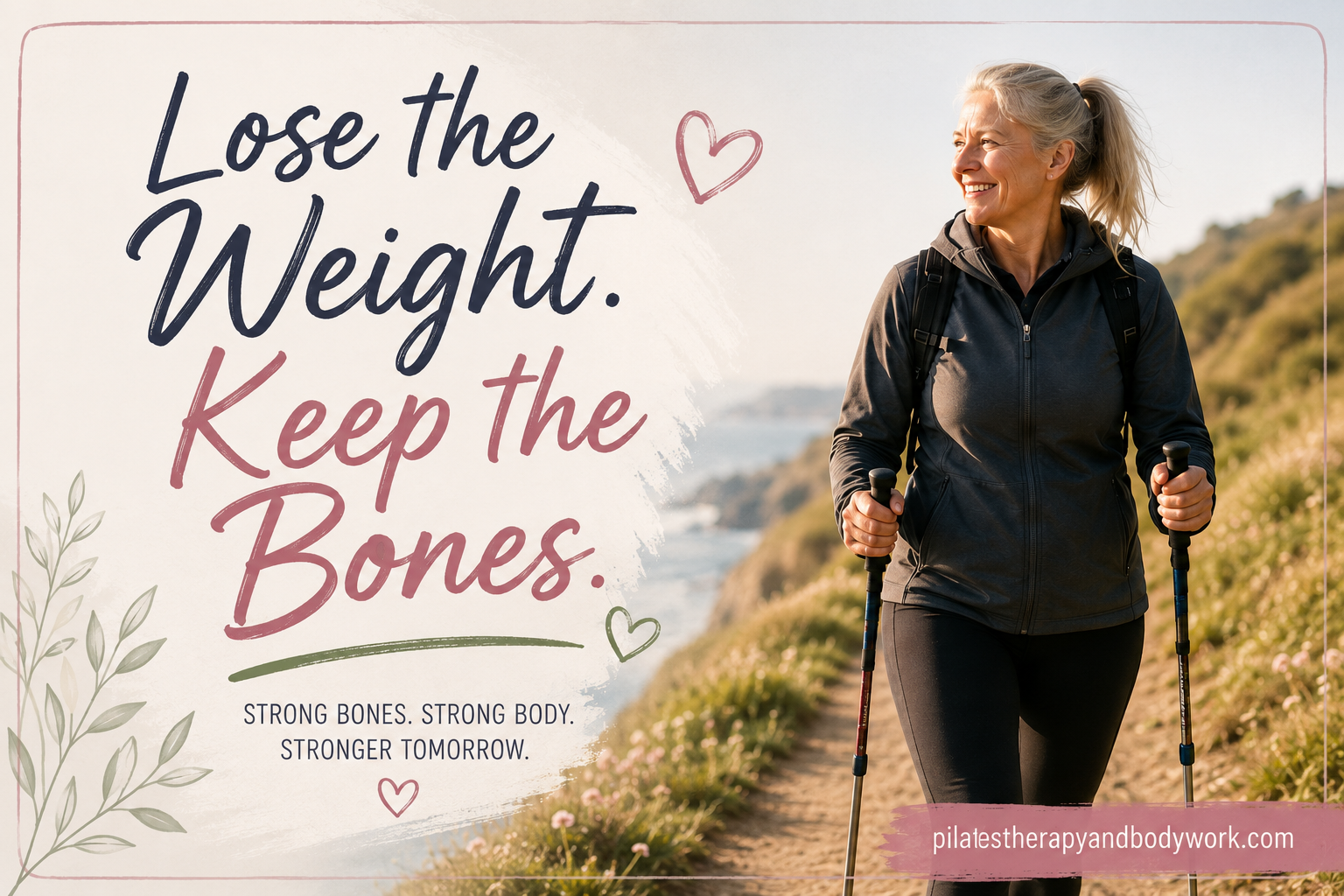
“Lose some weight.”
It’s probably one of the most common pieces of health advice given to women over 50.
For many of us, it makes perfect sense.
Less pressure on aching knees.
More energy.
Improved blood sugar.
Better heart health.
Clothes fitting a little more comfortably.
Perhaps even the confidence to say yes to things we’ve been putting off.
I’m on that journey myself.
As I write this, I’m just over 4 kilos lighter than I was. Like many people, I’m enjoying seeing the scales move, feeling my clothes loosen and discovering that walking no longer feels quite so hard.
I am up for my first review at Highwoods Nutrition. My brain wandered off in a very Fi direction.
Instead of asking,
“How much weight have I lost?”
I found myself asking,
“I wonder what my skeleton thinks about all of this?”
That probably won’t surprise anyone who knows me.
I seem incapable of accepting simple answers. One question nearly always leads to another.
And this question opened a fascinating door.
Because whilst my joints are undoubtedly thanking me for becoming lighter…
my bones may be quietly asking a completely different question.
The Good
Let’s start with the good news.
Losing excess body fat is one of the best things many of us can do for our long-term health.
Research consistently shows improvements in cardiovascular health, blood pressure, insulin sensitivity, mobility and quality of life following healthy weight loss. For many people, it also reduces the risk of conditions such as type 2 diabetes and several cancers.
My knees certainly seem happier.
And science agrees.
One of my favourite statistics is this:
For every pound of body weight lost, the load going through the knee during walking reduces by around four pounds.
Think about that for a moment.
Lose around 7 kg (15 lb), and every single step asks your knees to deal with considerably less force. Multiply that by the thousands of steps we take every day, and suddenly those small changes become enormous.
Fi Field Note
Imagine carrying a heavy backpack all day.
Now imagine taking it off.
Your shoulders sigh with relief.
Your knees probably would too.
That’s exactly what healthy weight loss can feel like.
So if you’re working hard to lose weight, celebrate it.
Your body almost certainly is.
But then my curiosity kicked in…
I found myself reading about bone.
Not because I have osteoporosis.
Not because someone had frightened me.
Simply because I wanted to understand what happens when the body suddenly becomes lighter.
And that’s when I discovered something that I don’t think enough people talk about.
Bones are incredibly clever.
They’re alive.
They’re constantly renewing themselves.
And, perhaps most importantly…
they’re always listening.
Not to our words.
To our movement.
To the forces we place through them.
Your Skeleton Is Surprisingly Economical
Imagine you own a warehouse.
Business is booming.
Orders are flying out of the door.
You employ plenty of staff because you need them.
Now imagine business gradually slows down.
You probably wouldn’t keep employing exactly the same number of people forever.
You’d quietly reduce the workforce to match the demand.
Our skeleton behaves in a surprisingly similar way.
Bone is expensive tissue to maintain.
If your body decides it doesn’t need quite so much…
it may gradually remove some.
Not because it’s broken.
Because it’s efficient.
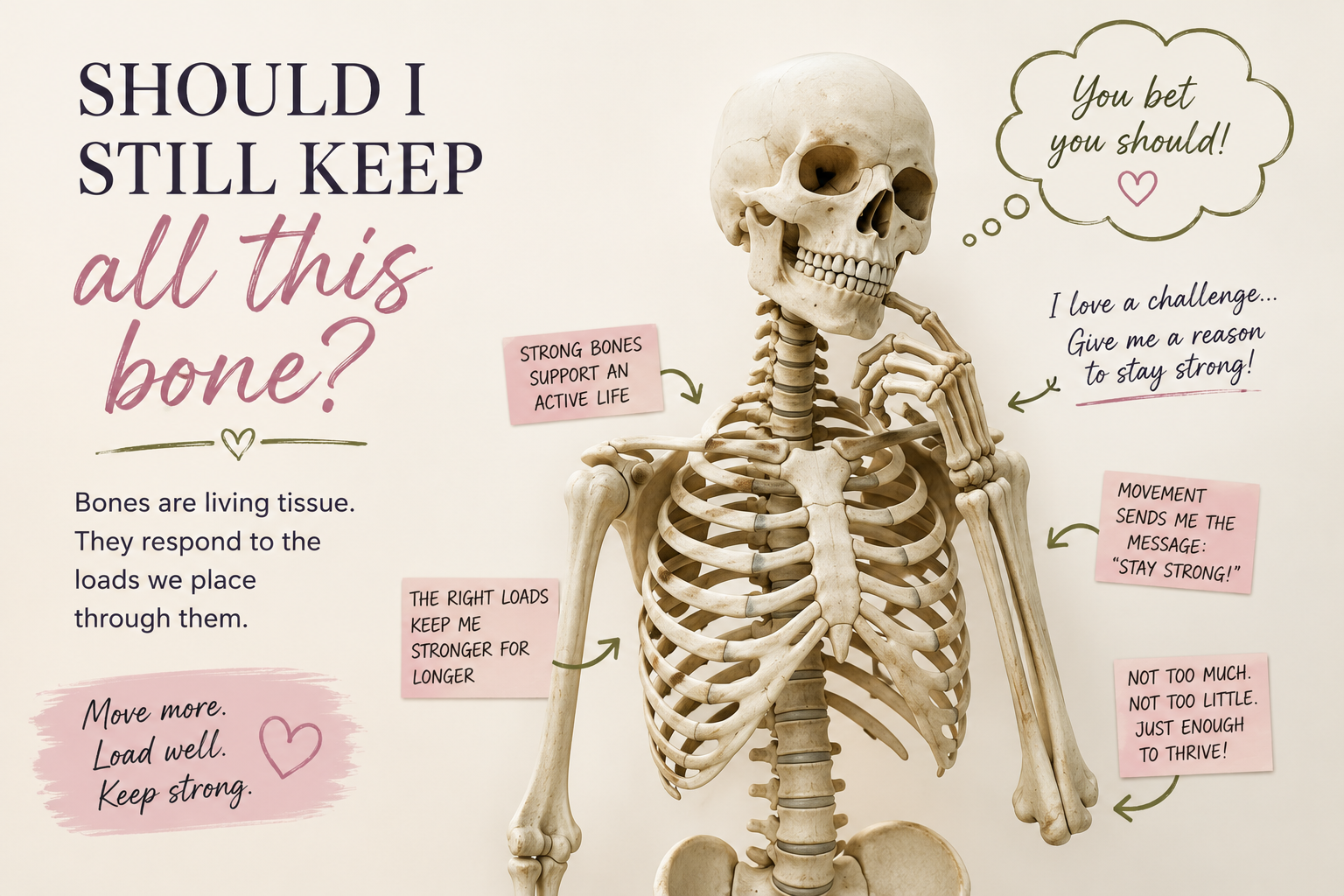
Scientists have known for well over a century that bone responds to the forces placed upon it. It’s often summarised by Wolff’s Law—the idea that bone continually remodels itself according to the loads it experiences.
In simple terms…
Bone asks one question.
“Do I still need to be this strong?”
Clinical Pearl
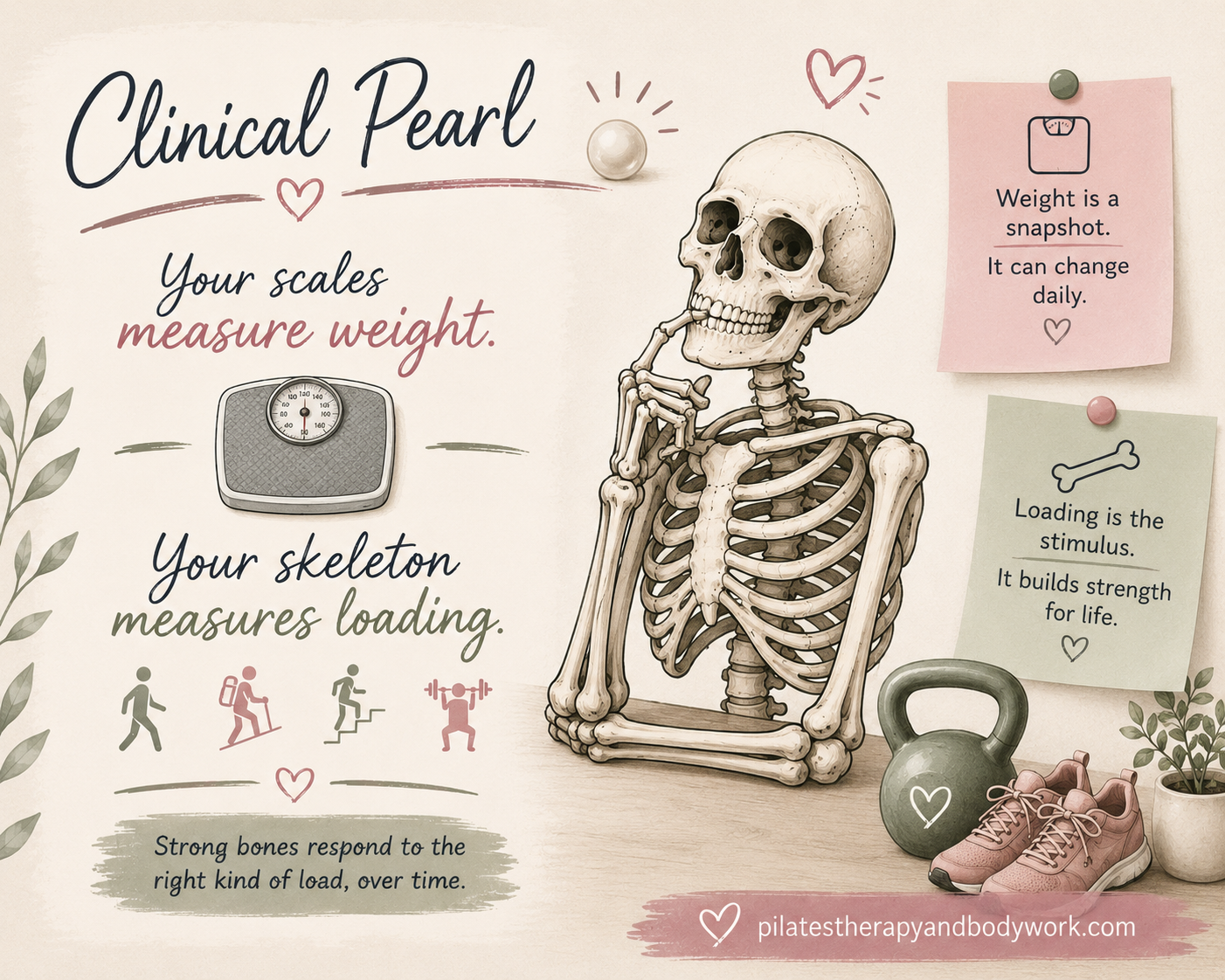
Your bathroom scales measure your body weight.
Your skeleton measures something completely different.
Loading.
And those are not the same thing.
So… Is Weight Good for Our Bones?
This is where things become wonderfully complicated.
For years, carrying more body weight was thought to protect bone because heavier bodies naturally place more force through the skeleton.
To some extent, that’s true.
Extra weight increases mechanical loading.
Bones generally respond to loading by becoming stronger.
But here’s the catch.
That same extra weight is also associated with increased inflammation, poorer mobility, a higher risk of falls, joint degeneration and changes in hormones and metabolism that may actually harm bone quality.
In other words…
being heavier isn’t automatically better for your skeleton.
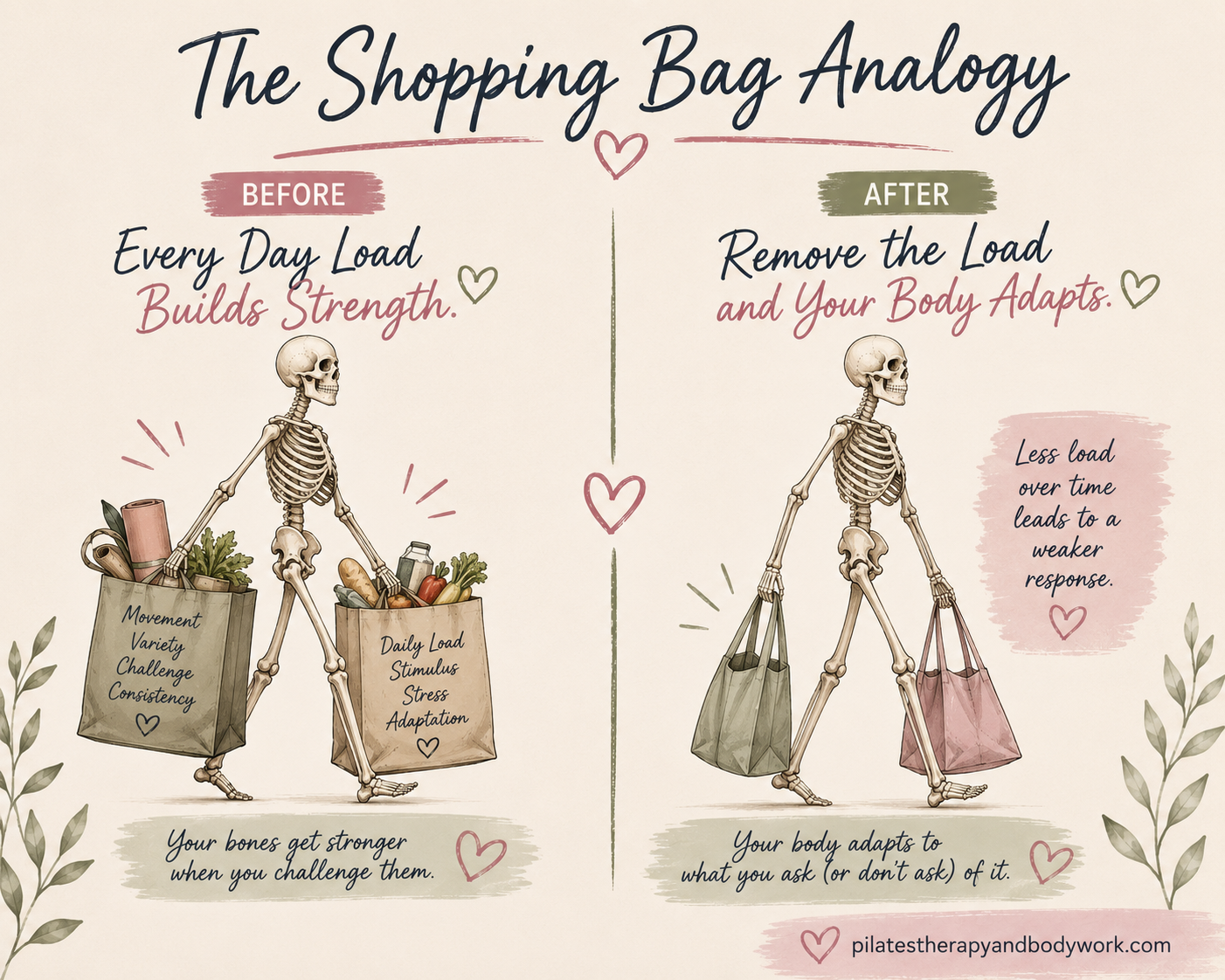
It’s a little like saying carrying heavy shopping all day makes you stronger.
Perhaps.
But if those shopping bags are damaging your knees, exhausting you and stopping you enjoying life…
are they really helping?
The answer isn’t simply more weight.
It’s better loading.
And that’s a very different conversation.
What Happens When We Lose Weight?
Now comes the really interesting bit.
As we lose weight, several things happen at the same time.
Our joints experience less force.
Our heart has less work to do.
Moving often becomes easier.
Many people naturally become more active.
All brilliant news.
But our bones also notice something.
The overall load travelling through the skeleton becomes smaller.
Imagine you’ve been carrying those heavy shopping bags every day for years.
Then one day…
you stop.
Your muscles adapt.
And your bones adapt too.
Research suggests that significant weight loss—particularly if it happens quickly or through calorie restriction alone—can be accompanied by a reduction in bone mineral density.
Now before anyone panics…
this isn’t a reason not to lose weight.
Far from it.
It’s simply a reminder that as we become lighter…
we also need to give our skeleton a reason to stay strong.
And that’s where movement becomes so much more than burning calories.
My joints love me being lighter.
My bones still need a reason to stay strong.
Fi Research Note
Studies looking at weight-loss programmes consistently show that combining healthy nutrition with resistance exercise and weight-bearing activity helps reduce the loss of bone mineral density compared with dieting alone.
In other words…
it’s not just about losing weight.
It’s about how we lose it.
Then Menopause Quietly Changes the Rules
If you’re reading this and you’re over fifty, there’s another piece of the puzzle that’s worth understanding.
Many of us don’t simply lose weight.
We lose weight during or after menopause.
And menopause changes the conversation.
As oestrogen levels fall, the rate at which bone is broken down begins to outpace the rate at which new bone is built. This is completely natural, but it does mean women can lose bone more quickly during the first few years after menopause.
Add weight loss into the mix and you can see why researchers have become interested.
Not because losing weight is bad.
Because the body is dealing with several changes all at once.
Hormones are changing.
Muscle can gradually decline if we don’t use it.
Balance often needs a little more attention.
Reaction times can slow.
And now we’ve become lighter as well.
Rather than frightening me, I actually find this quite empowering.
Because every single one of those things can be influenced by how we choose to move.
The Goal Isn’t to Be Thin
This is where I think we’ve got ourselves slightly lost.
For years the conversation has been about becoming smaller.
Smaller dress size.
Smaller waist.
Smaller number on the scales.
But perhaps the better question is…
What sort of body do I want to be living in twenty years from now?
Personally, I don’t want to be the smallest version of myself.
I want to be the strongest version of myself.
I want to be able to climb into Annie, our motorhome, without thinking about it.
I want to walk the coast.
Carry my shopping.
Get down onto the floor if I need to and, perhaps more importantly, get back up again.
I want to keep saying “yes” to life.
The scales don’t measure any of those things.
What Bones Really Love
Bones don’t read calorie counts.
They don’t know what size jeans you’re wearing.
They respond to something far simpler.
They respond to being used.
Every time your foot meets the ground…
Every time a muscle pulls on a bone…
Every time you step up onto a kerb…
Every time you stand up from a chair without using your hands…
…your skeleton receives tiny messages.
“We’re still doing this.”
“Stay strong.”
Those little messages matter.
Scientists call this mechanical loading.
I simply think of it as giving your skeleton a reason to keep turning up for work.
You may find Osteoporosis after cancer treatment and how do I know if I have low bone density useful.
Walking Is Wonderful… But Is It Enough?
Please don’t misunderstand me.
Walking is one of the best things we can do.
It supports heart health, mental wellbeing, mobility and longevity.
I absolutely love walking.
But if our goal is maintaining healthy bones as we age, research suggests we should think a little bigger.
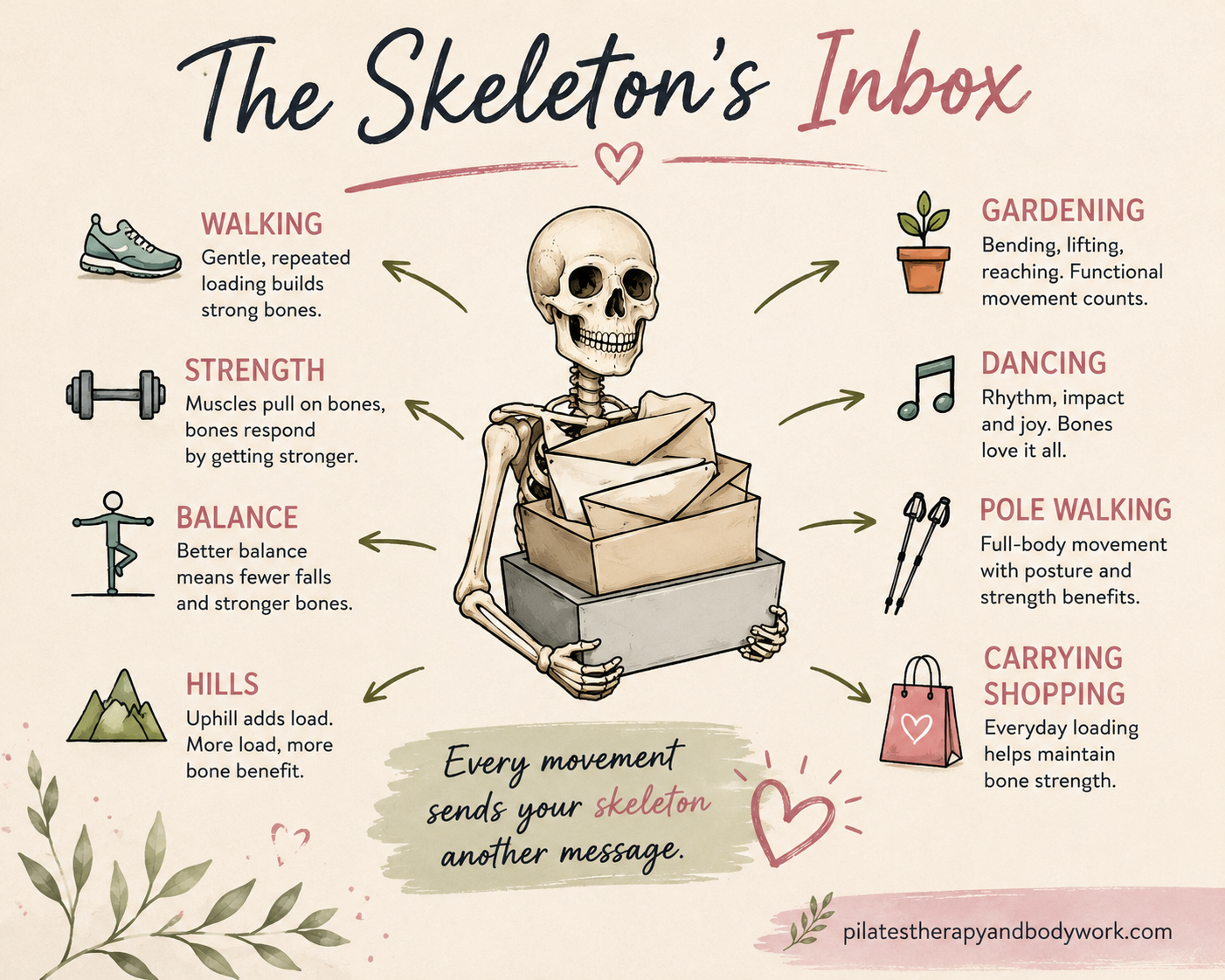
Bones appear to respond particularly well to movements that ask muscles to work harder or introduce varied loading patterns.
That might include:
- climbing hills
- carrying shopping
- strength training
- getting up and down from the floor
- step-ups
- dancing
- racket sports
- gardening
- lifting grandchildren
- and yes…
…walking with poles.
Not because poles are magical.
Because they encourage us to move more, move further, challenge our balance and involve the upper body in ways ordinary walking sometimes doesn’t.
For many people, they’re the stepping stone that makes regular movement enjoyable enough to become a habit.
And habits are where the magic really happens.
Fi Research Note
Current guidance for bone health doesn’t recommend relying on one type of exercise alone. The strongest evidence supports combining weight-bearing activity, muscle-strengthening exercise and balance training, particularly for women after menopause.
When I read that, I smiled.
Because it sounds remarkably like the kind of movement sessions I’ve spent years trying to create.
Not exercise for exercise’s sake.
Movement that prepares us for life.
A Different Way of Looking at Weight Loss
Here’s the thought I’d love to leave you with.
Imagine you’ve just lost 7 kilograms.
Your knees are delighted.
Your heart is grateful.
Your blood pressure may be improving.
Fantastic.
Now imagine saying to your skeleton…
“I’ve taken away some of the load you were carrying.”
Your skeleton replies…
“No problem… what would you like me to replace it with?”
Now that’s a question worth answering.
Not with fear.
With movement.
Maybe that’s strength work.
Maybe it’s dancing in your kitchen.
Maybe it’s gardening.
Maybe it’s walking the dog.
Maybe it’s climbing hills.
Maybe it’s learning to walk with poles.
The answer isn’t the same for everyone.
But the principle is.
Don’t simply take load away.
Replace it with purposeful movement.
Clinical Pearl
Weight loss should never be about becoming less.
It should be about becoming more capable.
Where My Curiosity Is Taking Me
This blog started with a question.
It hasn’t finished with an answer.
If anything, it’s given me even more questions to explore.
What kind of movement is best for our bones?
How much strength work do we really need?
Can we build stronger bones without spending hours in a gym?
Could an outdoor community, laughter, walking poles and a little bit of playful challenge actually tick more boxes than we realise?
That’s where my reading has taken me next.
And that’s exactly where I’ll take you in the next blog.
Because I think we’ve spent far too long chasing lighter…
…when perhaps we should have been chasing stronger all along.
On the Shoulders of Giants
One of the things I value most is learning from people who have dedicated their lives to understanding the human body.
This article draws on guidance and research from organisations including the Royal Osteoporosis Society, the NHS, the American College of Sports Medicine and researchers studying bone adaptation, menopause and healthy ageing.
As always, I’m simply trying to translate some fascinating science into everyday language that helps us all make better choices.
Because when we understand why our bodies respond the way they do…
looking after them becomes much less about fear…
and much more about curiosity.
And if you’ve followed my writing for a while…
you’ll know curiosity is one of my favourite places to begin.
“I’m incredibly grateful to Highwoods Nutrition for helping me on this journey. They are keeping me accountable and helping me lose weight in a sustainable way whilst continuing to enjoy real food. My role, as ever, is to ask the next question. Once the weight starts coming off, how do we help the body become stronger, more resilient and ready for the next chapter?”
Coming Next…
Why Women Over 50 Need to Stop Chasing Thin and Start Chasing Strong
Because staying independent, confident and adventurous has very little to do with the number on the scales…
…and everything to do with what your body can still say yes to.
- Further Reading
- Royal Osteoporosis Society – Bone health, menopause and exercise.
- NHS – Osteoporosis overview and prevention.
- American College of Sports Medicine – Position stands on physical activity, ageing and bone health.
- International Osteoporosis Foundation – Exercise recommendations for maintaining bone health.
- Wolff J. Das Gesetz der Transformation der Knochen (the foundational concept that bone adapts to the loads placed upon it).
- Kohrt WM et al. American College of Sports Medicine Position Stand: Physical Activity and Bone Health.
- Howe TE et al. Exercise for preventing and treating osteoporosis (systematic review).